
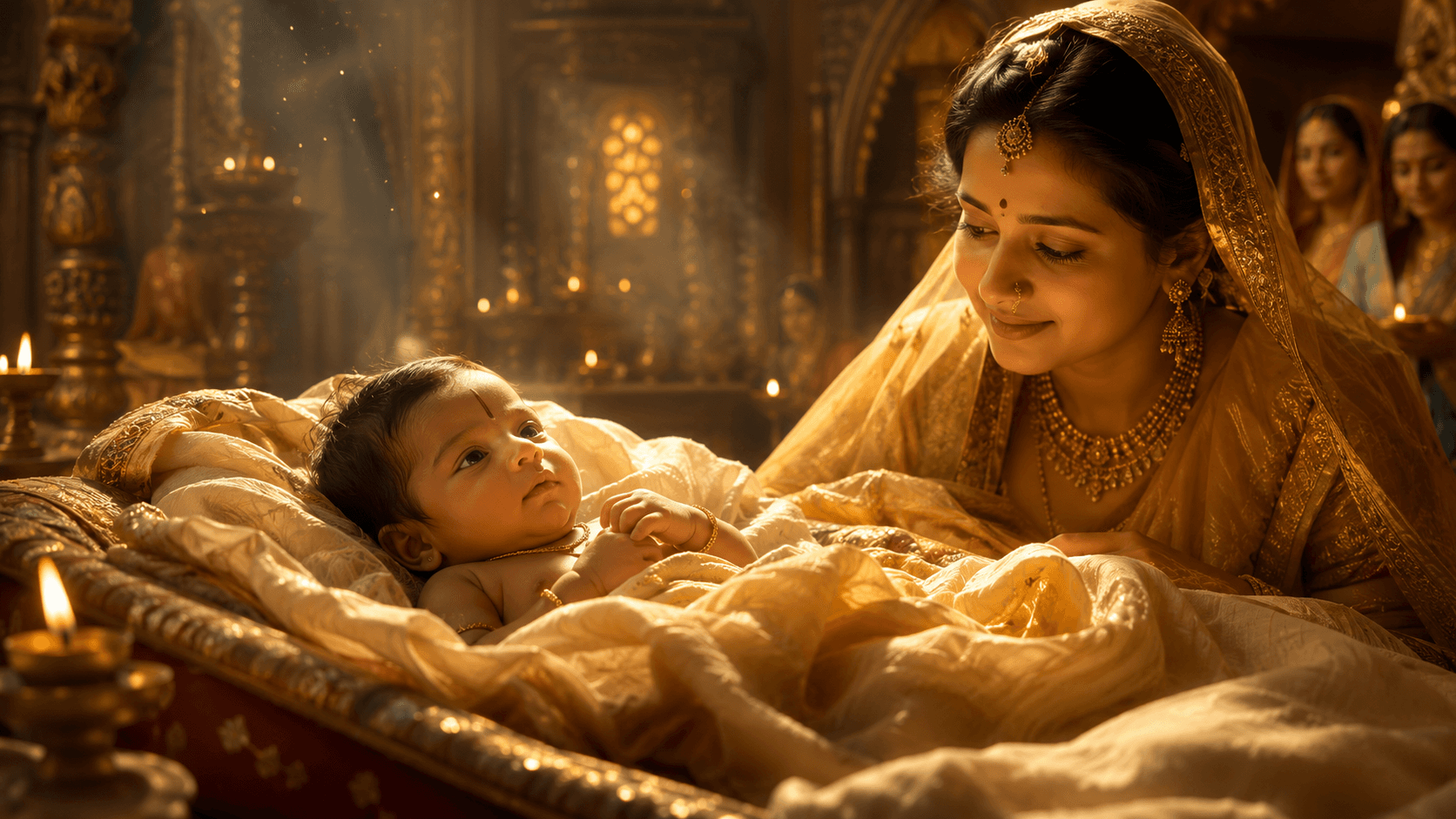
Ram Navami is not simply the birthday of a great king.
For devotees, it is the sacred day that remembers the appearance of Lord Rama in Ayodhya—the son of King Dasharatha and Queen Kausalya, and the divine ideal of Dharma, truth, courage and righteous conduct.
What makes the day even more fascinating is how carefully the scriptures describe His birth.
The Valmiki Ramayana records the lunar day, Nakshatra, Lagna and an extraordinary planetary alignment. Centuries later, Tulsidas described the same moment with the warmth of Bhakti: a peaceful midday when “Bhaye Pragat Kripala”—the Compassionate Lord appeared.
So what is the best Ram Navami mantra? What should a devotee chant on this day?
The answer can be beautifully simple:
Remember Shri Ram.
Devotees who take a special Japa Sankalpa can use the Ram Naam Japa Counter to count their Ram Naam on Ram Navami and continue the practice even after the festival has passed.
What Is Ram Navami and Why Is It Celebrated?
Ram Navami is observed on Chaitra Shukla Navami, the ninth lunar day of the bright fortnight of the month of Chaitra.
It commemorates the birth—or, in devotional language, the divine appearance—of Shri Ram in Ayodhya.
The Valmiki Ramayana describes Kausalya giving birth to Rama after King Dasharatha’s Putrakameshti sacrifice. The Bhagavata Purana and other later texts also remember Rama’s appearance in the lineage of Dasharatha. The attached research traces these textual traditions separately rather than treating every later detail as if it came from Valmiki himself.
For devotees, Ram Navami significance goes beyond remembering an event in the past.
It is a day to turn the mind again towards the values Shri Ram represents—and towards His Naam.
What Was Special About the Moment Lord Rama Was Born?
This is where Ram Navami becomes especially fascinating.
The Valmiki Ramayana, Bala Kanda 1.18.9–11, does not simply say that Rama was born.
It records an unusually detailed celestial setting:
ततश्च द्वादशे मासे चैत्रे नावमिके तिथौ।
नक्षत्रेऽदितिदैवत्ये स्वोच्चसंस्थेषु पञ्चसु॥
It continues by describing Cancer rising, Jupiter with the Moon, and Kausalya giving birth to Rama.
In simple terms, the text records Chaitra Navami, Punarvasu Nakshatra, Karka Lagna and five planets in exalted positions.
Chaitra Shukla Navami and Punarvasu Nakshatra
The phrase “nakṣatre ’diti-daivatye” refers to the Nakshatra whose presiding deity is Aditi—identified traditionally as Punarvasu Nakshatra.
The text also places Karka, or Cancer, as the Lagna, with Jupiter together with the Moon.
So when people search for Lord Rama birth Nakshatra, the strongest direct textual answer is:
Punarvasu Nakshatra.
These details come directly from the birth passage of the Valmiki Ramayana, rather than from a modern horoscope reconstruction.
The Five Exalted Planets at Rama’s Birth
Another remarkable phrase is:
“svocchasaṃstheṣu pañcasu graheṣu”
It states that five planets were in exalted positions.
But there is an important accuracy point.
Valmiki’s verse itself does not individually name all five planets in that phrase.
Traditional commentary identifies them as:
Sun, Mars, Jupiter, Venus and Saturn.
The commentary connects these planets with their traditional exaltation signs, but we should not rewrite that later interpretation as though Valmiki explicitly listed each planet by name in the verse.
This distinction matters when discussing Lord Rama birth planetary positions.
Scripture gives us the celestial framework.
Later Jyotisha tradition interprets the fuller configuration.
Was Lord Rama Born at Exactly Noon?
You will often hear:
“Lord Rama was born exactly at 12 noon.”
The tradition of celebrating Rama Janmotsava around Madhyahna, or midday, is well established.
But scripture should be quoted carefully.
The Valmiki Ramayana birth verses do not explicitly say “12:00 noon.” They describe the astronomical configuration surrounding Rama’s birth.
The Ramcharitmanas, however, gives us a clear poetic description of midday:
नौमी तिथि मधु मास पुनीता। सुकल पच्छ अभिजित हरिप्रीता।।
मध्यदिवस अति सीत न घामा। पावन काल लोक बिश्रामा।।
Tulsidas describes the sacred Navami, the bright fortnight, and a wonderfully peaceful midday—“madhyadivas”—neither oppressively hot nor uncomfortable.
So the accurate answer about Lord Rama birth time is:
The Ramcharitmanas explicitly places the sacred appearance scene at midday. Valmiki does not give a modern clock time such as exactly 12:00 PM.
That is more accurate than forcing later clock-time language into the ancient text.
Also Read: 108 Names of Lord Ram
Why Is Ram Navami Spiritually Special for Devotees?
Tulsidas describes the moment of Rama’s appearance with one of the most beloved lines in Rama Bhakti:
भए प्रगट कृपाला दीनदयाला कौसल्या हितकारी।
“The Compassionate One, merciful to the humble, appeared for the joy of Kausalya.”
The passage does not read like an ordinary birth announcement.
It is filled with devotion.
Tulsidas presents Rama’s appearance as a divine act of compassion and later writes:
बिप्र धेनु सुर संत हित लीन्ह मनुज अवतार।
He describes the Lord taking human form for the welfare of the righteous and sacred order.
This is why Ram Navami is special in Bhakti.
It is a day naturally filled with Rama Smarana—remembrance of Shri Ram.
Devotees may worship Sita-Rama, listen to the Ramayana or Ramcharitmanas, sing Bhajans, perform Kirtan, visit temples and take a special Ram Naam Japa Sankalpa.
There is no need to claim that chanting suddenly becomes “1,000 times more powerful” on this day.
Its spiritual importance is already beautiful without invented mathematics.
What Should You Chant on Ram Navami?
There is no single universally compulsory Ram mantra for Ram Navami.
For simple devotional practice, choose a Naam that brings your mind sincerely towards Shri Ram.
1. “Ram” or “Shri Ram” — The Simplest Ram Naam Japa
Sometimes the simplest Japa is the deepest:
राम
Ram
or
श्री राम
Shri Ram
You do not need a long mantra to remember God.
Repeat slowly.
Let each Naam become a return:
Shri Ram… Shri Ram… Shri Ram…
For someone wondering what to chant on Ram Navami, simple Ram Naam is a natural and accessible practice.
2. “Sita Ram”
You may chant:
सीता राम
Sita Ram
This remembers Mata Sita and Shri Ram together.
Tulsidas beautifully describes Sita and Rama as being like word and meaning, water and wave—distinguishable yet inseparable in his devotional vision.
For devotees drawn towards Sita-Rama Bhakti, Sita Ram can become a gentle, flowing Ram Navami chanting practice.
3. “Shri Ram Jai Ram Jai Jai Ram”
Another widely loved form is:
श्री राम जय राम जय जय राम
Shri Ram Jai Ram Jai Jai Ram
Its rhythmic form makes it suitable for both Japa and devotional Kirtan.
Different Rama traditions may use particular mantras according to Guru or lineage, so there is no need to declare one formula universally “the most powerful.”
The best Shri Ram mantra for your practice is one you can repeat with attention, devotion and consistency.
How Many Times Should You Chant Ram Naam on Ram Navami?
There is no universal scriptural command requiring every devotee to chant exactly 108, 1,008 or another fixed number specifically on Ram Navami.
You may voluntarily take a Sankalpa such as:
108 repetitions — one traditional mala
11 malas
1,008 Ram Naam
another meaningful personal target
These are devotional choices, not universal commandments.
A beginner may chant one peaceful mala with attention.
A regular practitioner may take a larger Ram Navami Japa Sankalpa.
The important thing is not to turn a sacred day into a race against a counter.
Let the number give structure to remembrance—not replace remembrance.
A Simple Ram Navami Japa Practice
Keep it uncomplicated.
Sit quietly and remember Shri Ram.
Choose one Naam:
Ram
Shri Ram
Sita Ram
or your regular Rama Nama or Guru-given mantra.
Take a realistic Sankalpa.
Chant slowly with Bhakti.
Use a Tulsi mala or digital counter when you want to track the repetitions.
Then spend a little time reading or listening to the Ramayana or Ramcharitmanas.
A beautiful Ram Navami mantra practice does not need to be complicated.
It needs your presence.
Other Traditional Ways to Observe Ram Navami
Across Hindu traditions and regions, devotees observe the day in different ways.
Common practices include Rama Puja, temple Darshan, Bhajan and Kirtan, Ramayana or Ramcharitmanas recitation, charity or Seva, and fasting according to personal capacity and tradition.
Many traditions celebrate Rama Janmotsava during Madhyahna, remembering the sacred midday appearance described so beautifully by Tulsidas. The attached research also notes that regional customs vary—from Ayodhya’s pilgrimage observances and Ramayana Path to Sita-Rama Kalyanam traditions in parts of South India.
These customs are meaningful traditions.
They should not all be presented as one compulsory ancient-scriptural rule for every devotee.
Make Ram Navami a Day of Ram Naam
Ram Navami comes once a year.
But Ram Naam does not have to leave when the festival ends.
Perhaps the deepest way to celebrate is not only to remember:
“Shri Ram appeared on this sacred day.”
But to ask:
“Can His remembrance remain with me tomorrow too?”
Take the Naam once:
Ram.
Then again.
Let your Ram Navami mantra become more than something chanted for one festival.
Let it become the beginning of a daily relationship with Shri Ram.
Frequently Asked Questions About Ram Navami and Chanting
What is the best mantra to chant on Ram Navami?
For simple Naam Japa, Ram, Shri Ram or Sita Ram are natural devotional choices. You may also chant Shri Ram Jai Ram Jai Jai Ram, or follow the Rama mantra taught by your Guru or tradition.
Which Nakshatra was Lord Rama born under?
The Valmiki Ramayana describes Rama’s birth under the Nakshatra presided over by Aditi, traditionally identified as Punarvasu Nakshatra. (Śrī Vālmīki Rāmāyaṇa)
Were five planets exalted when Lord Rama was born?
Yes. The Valmiki Ramayana explicitly says five planets were in exalted positions. The verse does not individually name all five there; traditional commentary identifies them as the Sun, Mars, Jupiter, Venus and Saturn. (Śrī Vālmīki Rāmāyaṇa)
Was Lord Rama born at noon?
The Ramcharitmanas explicitly describes the sacred appearance scene at “madhyadivas”—midday. It is more accurate to say midday or Madhyahna than to claim Valmiki explicitly wrote “12:00 noon.”
How many times should I chant Ram Naam on Ram Navami?
There is no universally required Ram Navami-specific count. 108 repetitions can form one traditional mala, while some devotees voluntarily choose larger Sankalpas. Choose a count you can complete sincerely.