
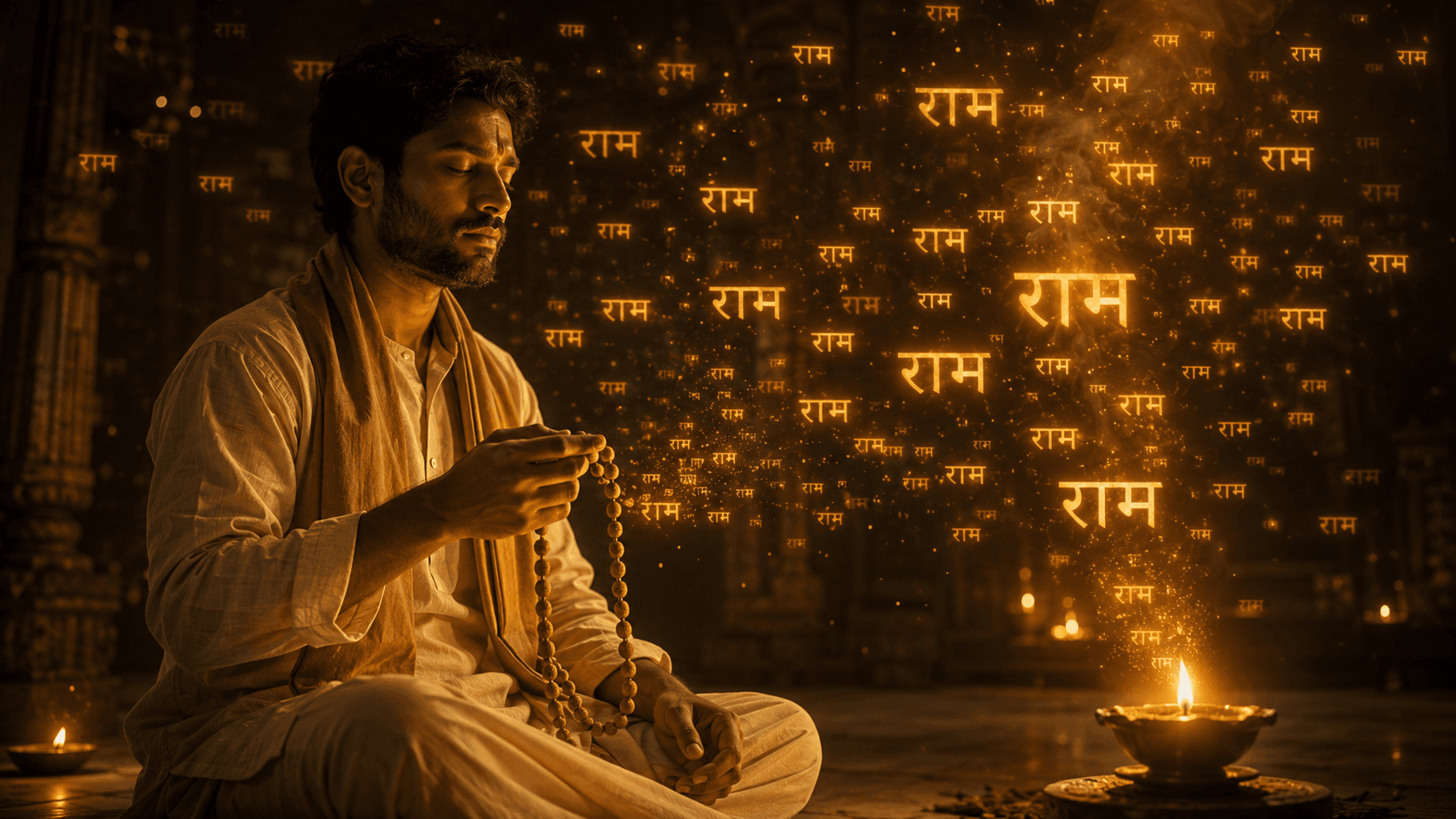
“Ram.”
Just one small name.
Yet for generations of devotees, Ram Naam has been far more than a word spoken by the lips.
It is remembrance.
It is devotion.
It is a way of turning the heart again towards Shri Ram.
In the Bhakti tradition, the Divine Name is deeply connected with the One being remembered. This is why Goswami Tulsidas gave Ram Naam such a special place in his writings.
But why is Ram Naam considered so powerful?
To understand the power of Ram Naam, we have to look beyond the sound itself—and see what happens when a name becomes a living remembrance of God.
You can use the Ram Naam Japa Counter to begin your Ram Naam Japa and make Divine remembrance part of your daily life.
What Does Ram Naam Mean?
“Ram Naam” means the sacred name of Lord Rama. In Sanskrit, it is often called Rama Nama.
When a devotee repeats “Ram,” “Shri Ram,” or another devotional form of Lord Rama’s name, it becomes Naam Japa—repeated remembrance through the Divine Name.
When that remembrance continues through daily life, it is often called Naam Smaran.
At its heart:
To take Ram Naam is to remember Shri Ram.
Why Is Ram Naam Considered So Powerful?
Its importance comes from remembrance.
Every time the mind returns to the Divine Name, it turns again towards the Divine.
The Divine Name Keeps the Devotee Connected With Lord Rama
The mind remembers many things—work, worries, conversations, plans.
But it easily forgets God.
Naam Japa gives it something sacred to return to:
Ram… Ram… Ram…
Again and again, the name brings Shri Ram back into awareness.
That is the heart of Naam Smaran.
Over time, this repeated return can make remembrance of God more natural.
Naam and Naami: The Name and the One Being Remembered
Tulsidas speaks beautifully about Naam—the Name—and Naami—the One whose name is taken.
In the Ramcharitmanas, Bala Kanda 1.21, he writes:
समुझत सरिस नाम अरु नामी।
प्रीति परसपर प्रभु अनुगामी।।
In simple words, the Name and the Named are understood as deeply connected through love.
Tulsidas then explains that even without seeing the form, remembering the name can bring loving remembrance into the heart.
You may not be in Ayodhya or inside a temple.
But when you say “Ram” with devotion, your mind turns towards Him.
Ram Naam Makes Divine Remembrance Simple and Accessible
Not everyone can perform long rituals or visit a temple every day.
But the Divine Name can remain close.
You can remember Ram while sitting quietly, walking, waiting, or moving through an ordinary day.
That simplicity helps remembrance remain part of life, not separate from it.
Also Read: How Many Times Should You Chant Ram Naam Daily?
Ram Naam Mahima in the Ramcharitmanas
Goswami Tulsidas gives some of the most beautiful descriptions of Ram Naam Mahima in the opening part of the Ramcharitmanas.
“Ram Naam” as a Lamp of Inner and Outer Light
One of the best-known verses says:
राम नाम मनिदीप धरु जीह देहरी द्वार।
तुलसी भीतर बाहेरहुँ जौं चाहसि उजिआर।।
— Ramcharitmanas, Bala Kanda, Doha 21.
Tulsidas asks us to place the jewel-like lamp of Ram Naam at the doorway of the tongue if we wish for light within and outside.
A lamp does not argue with darkness.
It simply shines.
In the same way, Tulsidas presents Ram Naam as something to keep close—on the tongue and in remembrance—like a lamp guiding life.
This is devotional poetry, not a scientific claim.
Ram Naam as a Source of Spiritual Welfare
Another famous verse by Tulsidas says:
नामु राम को कलपतरु, कलि कल्यान निवासु।
जो सुमिरत भयो भांग तें, तुलसी तुलसीदासु॥
This verse is from Tulsidas’s Dohavali, not the Ramcharitmanas.
The source identifies Ram Naam here as a Kalpataru and a dwelling place of kalyan—spiritual welfare—in Kaliyuga.
Its meaning should not be reduced to:
“Chant Ram and every material wish will come true.”
The deeper message is transformation through Divine remembrance.
A life that repeatedly turns towards God does not remain untouched by that remembrance.
What Does “Ram Se Bada Ram Ka Naam” Really Mean?
You may have heard:
“Ram se bada Ram ka Naam.”
This popular wording is not a direct quotation from the Ramcharitmanas.
But it reflects an idea that Tulsidas does express.
In Bala Kanda 1.23, he writes:
कहउँ नामु बड़ राम तें निज बिचार अनुसार।।
Tulsidas clearly frames this as his own devotional understanding: he speaks of the Name as greater than Ram.
But what does that really mean?
It does not mean that the word “Ram” is some separate power competing with Lord Rama.
The devotional idea is about the extraordinary accessibility of the Divine Name.
A devotee cannot always see the Lord’s form, go to Ayodhya, or perform elaborate worship.
But the Name?
The Name can remain on the tongue.
The Name can remain in the heart.
Wherever the devotee goes, remembrance can go too.
That is the beauty behind the expression:
“Ram se bada Ram ka Naam.”
Why Saints Gave So Much Importance to Ram Naam
Goswami Tulsidas and the Glory of Ram Naam
In Bala Kanda, Tulsidas reflects on Naam and Naami, compares Ram Naam to a lamp, and speaks of the extraordinary greatness of the Name from his devotional viewpoint.
For him, Ram Naam is not merely something to discuss.
It is something to remember.
Something to live with.
Hanuman and Constant Remembrance of Shri Ram
Hanuman represents Bhakti in action through love, service, courage and surrender to Shri Ram.
His example reminds us of something important:
Naam is not meant to remain only on the lips.
Its deeper direction is towards a life centered more and more on the One being remembered.
The tongue says:
Ram.
The heart remembers:
Shri Ram.
And slowly, devotion begins to shape the way we live.
Also Read: How to Chant Ram Naam
Why Ram Naam Is Especially Significant in Kaliyuga
According to Hindu devotional tradition, remembrance of God is considered especially accessible in Kaliyuga.
In the Ramcharitmanas, Uttara Kanda 7.103, Tulsidas writes:
कलिजुग जोग न जग्य न ग्याना।
एक अधार राम गुन गाना।।
And shortly after:
नाम प्रताप प्रगट कलि माहीं।।
The passage gives special importance to devotion, singing the qualities of Ram, and the glory of the Divine Name in the age of Kali.
This is a theological teaching of the Bhakti tradition.
Its message is hopeful.
Even when life feels complicated, remembrance of God does not have to be complicated.
You may not know difficult Sanskrit.
You may not understand every scripture.
You may not be able to perform long rituals.
But you can remember.
Ram.
The door of Naam remains simple.
Is the Power in the Word “Ram” or in Devotion?
Should we think of “Ram” as a magical sound that automatically gives whatever we ask for?
That would miss the heart of Bhakti.
Ram Naam Japa brings together:
the sacred Name,
faith,
Bhava—devotional feeling,
remembrance,
and regular practice.
Sometimes devotion feels strong.
Sometimes the mind wanders.
Still, you return:
Ram.
The purpose is not to control God through repetition.
The purpose is to remember Him.
A mala or counter can help build discipline.
But the real movement is always the same:
from forgetting to remembering.
That is perhaps one of the simplest ways to understand the spiritual significance of Ram Naam.
From Understanding Ram Naam to Practicing It
You can read many pages about Ram Naam Mahima.
But eventually, reading has to become remembrance.
Sit quietly.
Take the Name.
Let one repetition lead to another.
Experience the Power of Ram Naam Through Practice
Perhaps the power of Ram Naam cannot be understood only by reading about it.
A lamp is understood more deeply when it is lit.
In the same way, the Mahima of Ram Naam unfolds in Bhakti through remembrance, faith and practice.
You do not need to begin with a thousand repetitions.
Begin with one sincere remembrance.
Ram.
Then return again.
Because Ram Naam is not merely a subject to study.
It is a Name to remember.
Frequently Asked Questions About the Power of Ram Naam
Why is Ram Naam considered powerful?
In the Bhakti tradition, Ram Naam is considered spiritually powerful because it keeps the devotee connected with Shri Ram through remembrance, devotion and faith. Tulsidas gives the Divine Name an extraordinary place in the Ramcharitmanas.
What does Ram Naam Mahima mean?
Mahima means glory, greatness or spiritual significance. Ram Naam Mahima means the glory and spiritual importance of Lord Rama’s Divine Name.
What does “Ram se bada Ram ka Naam” mean?
It expresses the Bhakti idea of the extraordinary accessibility and glory of the Divine Name. The popular phrase itself is not a direct scripture quotation, though Tulsidas expresses a closely related idea in Ramcharitmanas, Bala Kanda 1.23. It should not be understood as making Ram Naam and Lord Rama separate rivals.
Is chanting Ram Naam the same as chanting a Ram mantra?
Not always. Ram Naam usually means remembering or repeating Lord Rama’s sacred name. A Ram mantra may be a longer, specific sacred formula with its own traditional form.
How can I start chanting Ram Naam?
Begin simply. Choose a form of Ram Naam, sit quietly, and repeat it with attention and devotion. For practical guidance, read How to Chant Ram Naam: Method, Rules and Beginner’s Guide.