
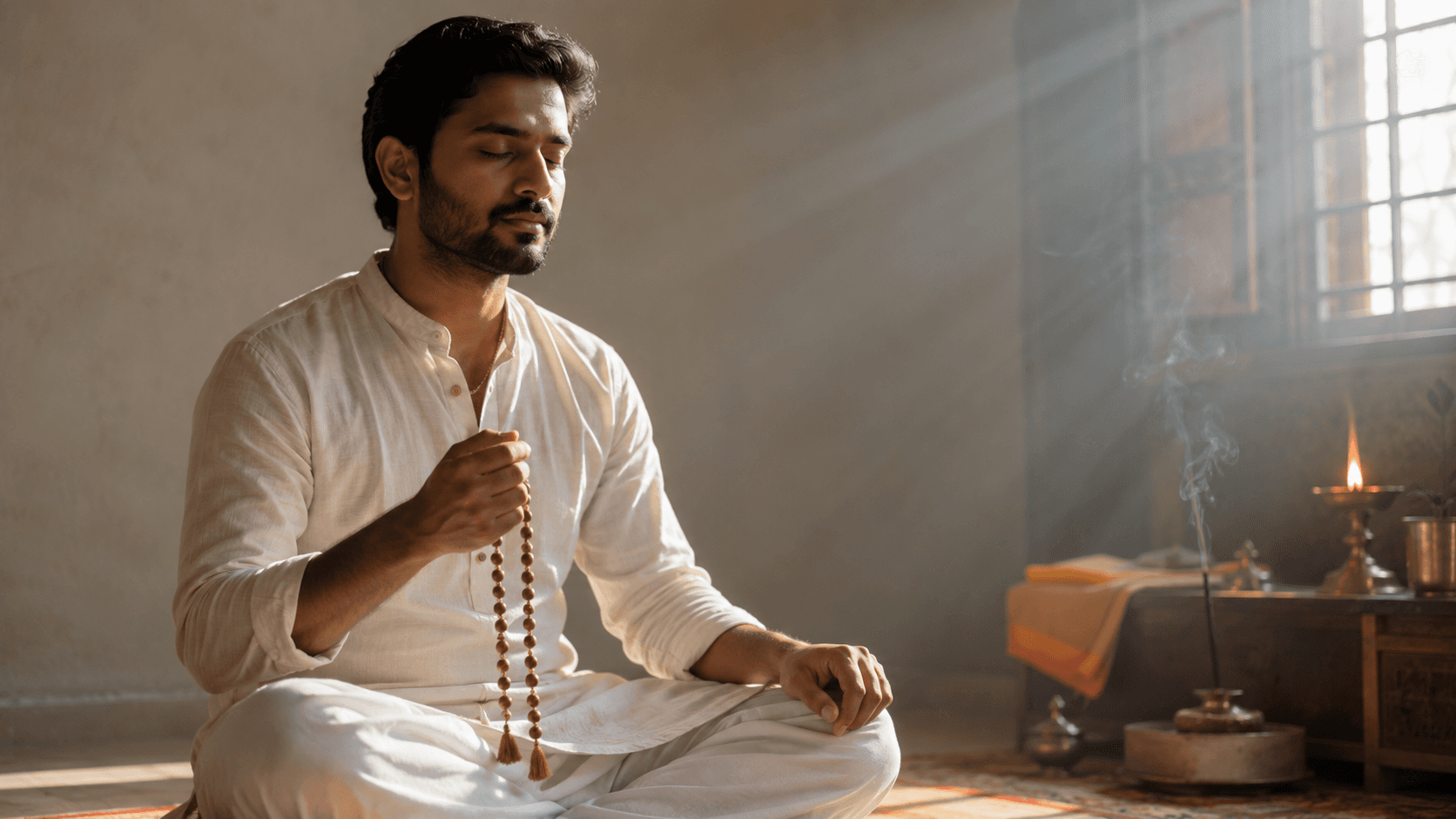
You feel drawn towards Ram Naam.
But then the questions begin.
Which Naam should I chant? Should I use a mala? Should I say it aloud or silently? Is there a right time? What if my mind keeps wandering?
Take a breath.
Ram Naam Japa does not have to begin with confusion.
At its heart, it is very simple:
Remember Shri Ram. Repeat His name. Return to Him again and again.
You can begin with sincerity, attention, and a few quiet minutes every day.
This guide will show you how to chant Ram Naam step by step—without making a beautiful spiritual practice unnecessarily complicated.
You can use the Ram Naam Japa Counter when you want to keep track of your chanting and build a regular daily practice.
What Is Ram Naam Japa?
Ram Naam Japa means repeating the name of Lord Rama as a spiritual practice.
You may repeat:
Ram
Ram Ram
Shri Ram
Sita Ram
Jai Shri Ram
The purpose is not only to repeat a word.
It is to remember the One whose name you are repeating.
This is why Japa is also connected with Naam Smaran—the remembrance of God.
Tulsidas gives a beautiful image in the Ramcharitmanas:
राम नाम मनिदीप धरु जीह देहरीं द्वार।
तुलसी भीतर बाहेरहुँ जौं चाहसि उजिआर॥
He compares Ram Naam to a precious lamp placed at the doorway of the tongue—bringing light within and outside. This verse appears in the Ramcharitmanas, Bala Kanda, Doha 21.
You do not need to understand every philosophy of Japa before starting.
Sometimes, practice comes first. Understanding grows with it.
Which Ram Naam Should You Chant?
There is no need to become confused by too many choices.
For simple Ram Naam Japa, choose a form of the name that naturally brings devotion to your heart.
It may be as simple as:
“Ram”
or
“Shri Ram”
or
“Sita Ram.”
Some devotees also chant longer forms such as “Shri Ram Jai Ram Jai Jai Ram.” That mantra has its own tradition and can be explored separately in more detail.
For a beginner, the simplest advice is:
Choose one Naam. Stay with it during your Japa.
Do not spend your whole practice wondering whether another version is “more powerful.”
The heart of Japa is not constant comparison.
It is constant remembrance.
Also Read: Power of Ram Naam
How to Chant Ram Naam Step by Step
You do not need a complicated ceremony to begin.
Here is a simple Ram Naam Japa method for beginners.
1. Choose a Quiet and Comfortable Place
Find a place where you can sit without too much disturbance.
It may be:
your prayer room
a quiet corner of your bedroom
a peaceful place near a window
a temple
anywhere you feel comfortable and respectful
A quiet place helps beginners because the mind already has enough distractions.
But remember:
Shri Ram is not limited to one room.
A fixed place can help build discipline, but Ram Naam itself can travel with you everywhere.
2. Sit Comfortably and Settle Your Mind
Sit in a position you can maintain comfortably.
You may sit cross-legged on the floor, on a cushion, or on a chair if that is easier for you.
There is no benefit in forcing yourself into a difficult posture and spending the whole Japa thinking about your knees.
Keep your body relaxed.
Take a few slow breaths.
Let the rush of the day settle for a moment.
Then bring Shri Ram into your awareness.
You may simply think:
“Prabhu, let me remember You for these few minutes.”
That simple intention can become your Sankalp for the practice.
3. Choose the Form of Ram Naam You Want to Repeat
Now choose your Naam.
For example:
Shri Ram… Shri Ram… Shri Ram…
Stay with the same form during that session.
There is something powerful about simplicity.
When you stop changing the words, the mind slowly has fewer decisions to make.
It can simply return to the Naam.
Again.
And again.
4. Chant Slowly With Attention and Devotion
Do not race.
Japa is not a competition.
It is easy to become focused on numbers:
How quickly can I finish 108?
How many malas can I complete?
But if the tongue is saying “Ram” while the mind is running everywhere else, slow down.
Say the Naam with awareness.
Ram.
Know whose name you are taking.
Ram.
Let there be a small feeling of remembrance.
Ram.
This feeling is often called Bhava—the inner feeling or devotion behind the practice.
Your attention will not remain perfect.
That is normal.
The mind may wander ten times.
Bring it back eleven times.
That returning is also part of Japa.
Traditional Japa guidance strongly emphasizes unhurried repetition, attention, feeling, and regularity rather than rushing simply to complete a count.
5. Use a Mala or Counter to Keep Track
Counting can help you stay focused and build a regular practice.
Traditionally, many devotees use a Tulsi mala with 108 beads for Japa. The Divine Life Society’s traditional guidance on Japa also describes the use of a 108-bead Tulsi or Rudraksha mala.
With a mala, one bead usually marks one repetition.
But a mala is not the only way to remember Shri Ram.
You can also chant without counting.
Or you can use a digital counter when that is more practical.
The tool should serve your devotion—not become the purpose of it.
Count the Naam if it helps you stay regular. But never let the number become greater than the remembrance.
6. Finish Quietly and Carry Ram Naam With You
When your Japa is complete, do not feel that you must jump up immediately.
Pause.
Sit quietly for a few moments.
Let the Naam remain with you.
Traditional Japa guidance also recommends a quiet period after formal repetition and encourages continuing remembrance during daily activity.
Then continue your day.
Your seated Japa may have ended.
But your remembrance does not have to.
While walking…
While waiting…
While travelling…
A quiet “Ram” can return.
This is where Japa slowly begins to become Naam Smaran.
Also Read: Benefits of Chanting Ram Naam
Should Ram Naam Be Chanted Aloud, Whispered or Silently?
Traditional Japa practice commonly describes three ways of repetition.
You do not need to worry about finding the “perfect” one on your first day.
Spoken Japa — Vaikhari
Here, you chant Ram Naam in an audible voice.
“Shri Ram… Shri Ram…”
This can be helpful for beginners because hearing the Naam gives the mind something clear to follow.
When the mind feels very restless, spoken Japa may help bring attention back.
Whispered Japa — Upanshu
In Upanshu Japa, the Naam is repeated very softly.
Your lips may move, but the sound is low—almost like a whisper meant only for you.
It can feel more inward than spoken Japa while still giving you some support through sound.
Mental Japa — Manasik
In Manasik Japa, Ram Naam is repeated silently within the mind.
No audible sound is needed.
Traditional teachers distinguish spoken, whispered, and mental forms of Japa, while also using them practically according to the state of the mind.
Different traditions may give different importance to these methods.
As a beginner, choose the one that helps you remember Shri Ram with sincere attention.
When the mind becomes too distracted during silent Japa, you can gently return to a soft or audible repetition.
There is no need to turn Japa into an exam.
What Is the Best Time to Chant Ram Naam?
Traditionally, Brahma Muhurta and the quiet early-morning period are considered especially suitable for Japa and meditation.
Dusk and evening are also traditionally valued times for spiritual practice.
Early morning has a practical beauty too.
The world is quieter.
The phone has not yet taken over.
The mind has fewer unfinished conversations running through it.
But here is something important:
Do not wait for the perfect time and never begin.
If 5 a.m. does not work for your life, chant at 7 a.m.
Or in the evening.
Or before sleeping.
A sincere practice you actually do is better than a “perfect routine” that exists only in your plans.
The best time to chant Ram Naam is a peaceful time you can return to regularly.
Simple Rules for Ram Naam Japa
There are many customs connected with different traditions.
But for a simple beginner’s practice, remember these four principles.
Be Regular Rather Than Irregular
Five sincere minutes every day can build a stronger habit than one long session followed by many days of nothing.
Try to give Ram Naam a small place in your daily life.
Protect that place.
Do Not Rush Just to Increase the Count
Numbers can motivate you.
But numbers can also distract you.
Do not turn:
“Ram… Ram… Ram…”
into a race against the counter.
Let every repetition be a small return.
Bring the Mind Back When It Wanders
Your mind will wander.
Do not think:
I cannot do Japa.
Simply notice it.
Then come back:
Shri Ram.
That is all.
You may have to do this many times.
Keep coming back.
Let Devotion Matter More Than Technique
Technique can help.
Posture can help.
A mala can help.
A quiet place can help.
But none of these should make you forget why you came.
You came to remember Shri Ram.
As the Bhagavad Gita says:
यज्ञानां जपयज्ञोऽस्मि
In Bhagavad Gita 10.25, Shri Krishna identifies Himself with Japa Yajna among forms of sacrifice, showing the honored place of sacred repetition within the tradition.
Common Mistakes Beginners Should Avoid
Do not become obsessed with numbers.
A bigger count is not automatically a deeper Japa.
Do not chant so fast that the Naam becomes unclear.
Slow down enough to remain aware.
Do not keep changing your Naam every few minutes.
Give the mind one simple point of remembrance.
Do not quit because your mind wanders.
A wandering mind does not mean your practice has failed.
Do not become trapped in rules.
Traditional customs can support Japa, but simple remembrance of Ram Naam should not become a source of fear.
And most importantly:
Do not wait to become a “perfect devotee” before beginning.
Japa is part of the journey.
You do not need to finish the journey before taking the first step.
Begin Your Ram Naam Japa Practice
Maybe you still feel you are not ready.
Your mind is not peaceful enough.
Your routine is not perfect.
You do not know enough.
But perhaps you do not need to wait.
Sit for a moment.
Take the Naam once.
Ram.
Then once again.
Ram.
Do not worry today about how far the path goes.
Just take the next step.
Because Ram Naam Japa does not begin when everything becomes perfect.
It begins the moment you remember Him.
Frequently Asked Questions About Chanting Ram Naam
Can anyone chant Ram Naam?
Simple remembrance of Lord Rama’s name is widely practised as a form of devotion. You can begin with a sincere and respectful heart. You do not need to make the practice complicated before taking the name of Shri Ram.
Do I need a Guru or initiation to chant Ram Naam?
There is an important difference between simply remembering and chanting the name of Ram and practising a specific Guru-mantra received within a particular spiritual lineage. Initiated mantras may have instructions given by the Guru or tradition. For simple Ram Naam Smaran—such as repeating Ram, Shri Ram, or Sita Ram—do not let fear about complex rules stop sincere remembrance. When following a particular Sampradaya or Guru, follow the guidance of that tradition.
Can I chant Ram Naam without a mala?
Yes. A mala helps with counting and concentration, but Ram Naam is not dependent on beads. You can repeat it mentally, count in another simple way, or use the Ram Naam Japa Counter to keep track of your practice.
Can Ram Naam be chanted while walking or doing daily activities?
Yes, as informal Naam Smaran. Focused seated Japa gives you dedicated time when your attention is mainly on the Naam. During normal life, you can also remember Ram while walking, travelling, or doing simple daily tasks. Both can have a place in spiritual life.
How many times should I chant Ram Naam daily?
There is no single number that every beginner must follow. Some people begin with a few minutes. Others choose a fixed count such as 108. Start with something you can follow regularly without turning Japa into pressure.