
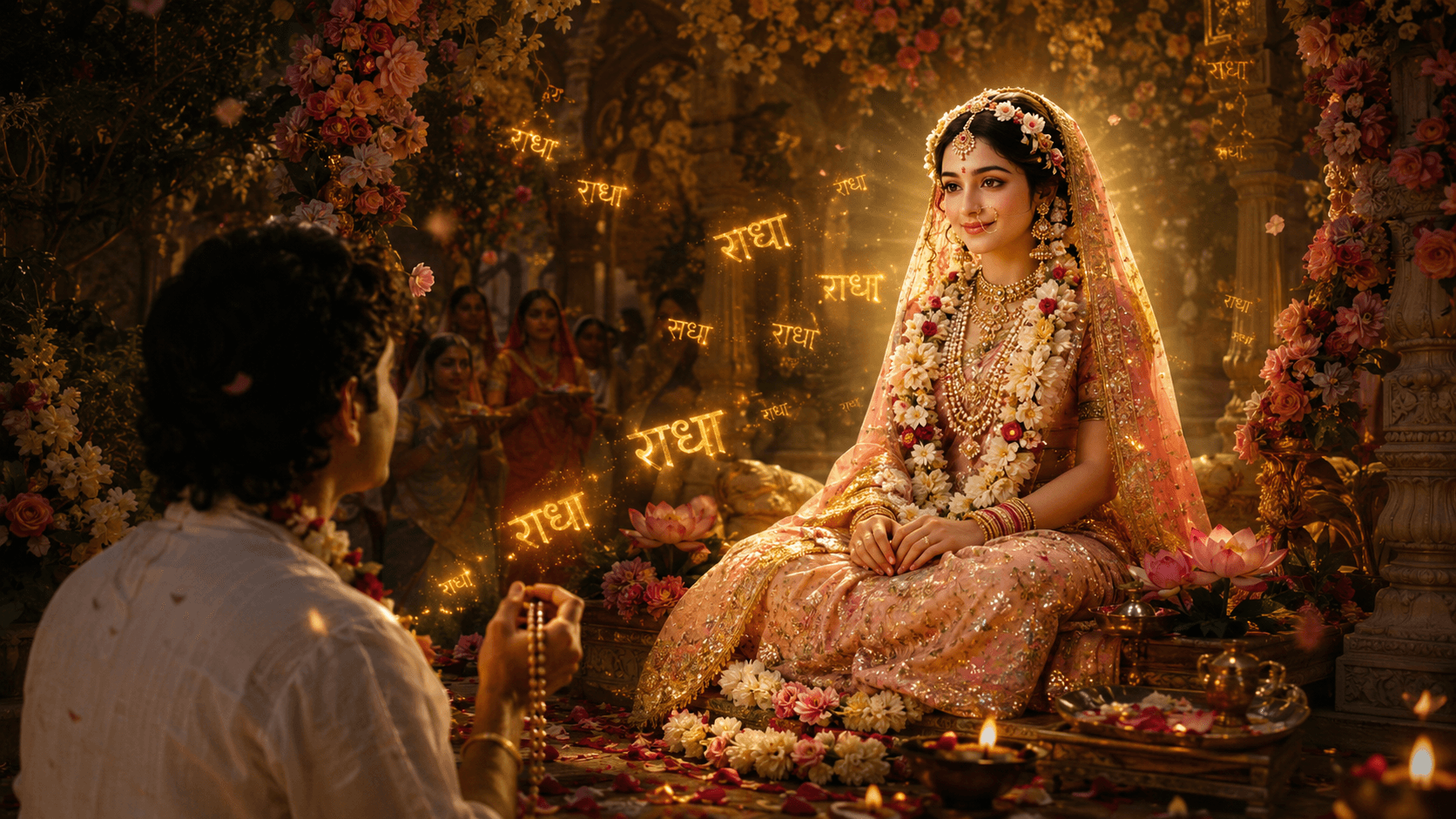
Krishna Janmashtami is known throughout the world. But only a short time later comes another deeply sacred day in Braj:
Radhashtami—the appearance day of Shri Radha Rani.
If this day belongs especially to Shriji, what should a devotee actually do? Is there a special Radhashtami mantra? Should you chant “Radha,” “Radhe Radhe,” a Radha-Krishna mantra, or something longer?
The answer does not need to be complicated.
Radhashtami is traditionally observed on Bhadrapada Shukla Ashtami, and one of the simplest personal offerings is the Name itself:
Radha… Radha…
A devotee can take a special Sankalpa for the day and use the Radha Naam Japa Counter to track formal Japa while keeping attention on remembrance rather than manual counting.
The festival lasts for a day.
The remembrance it awakens does not have to.
What Is Radhashtami?
Radhashtami, also called Radha Ashtami, commemorates the appearance of Shri Radha.
It is observed on:
Bhadrapada Shukla Ashtami
—the eighth lunar day of the bright fortnight of Bhadrapada.
In the traditional lunar sequence, this comes roughly fifteen days after Krishna Janmashtami.
Shri Radha holds an especially central place in many Krishna-bhakti traditions, while Braj—particularly Barsana and Vrindavan—has some of the deepest living traditions of Radhashtami celebration.
Different Sampradayas do not necessarily describe every detail of Shri Radha’s appearance or theological position in exactly the same way.
That distinction matters.
For example, the Radha Vallabh tradition has its own strongly Radha-centred devotional language, while Gaudiya Vaishnavism approaches Radha-Krishna through its own theological framework.
Radhashtami brings these traditions together in celebration of Shri Radha without requiring us to pretend that all of them are doctrinally identical.
Why Is Radhashtami Spiritually Special?
The Radhashtami significance is deeper than simply saying:
“It is Radha Rani’s birthday.”
For devotees, the day turns attention toward what Shri Radha represents within Radha-centred Bhakti.
Shri Radha Represents the Highest Language of Divine Love
In Radha-centred Vaishnava and Vrindavan traditions, Shri Radha is associated with Prem—selfless Divine love.
Her devotion to Krishna is spoken of through the language of:
complete surrender;
loving service;
intimacy with the Divine;
grace;
love without calculation.
That is why Radhashtami naturally becomes a day not only to worship Shriji, but to ask:
What kind of love am I bringing into my own spiritual life?
Do I remember the Divine only when I need something?
Or can devotion gradually become love for its own sake?
Radhashtami Is a Day of Radha Smaran
A festival becomes spiritually meaningful through Smaran—remembrance.
Flowers are beautiful.
Temple decorations are beautiful.
Bhajan and darshan are beautiful.
But all of them point toward one thing:
Remember Shri Radha.
That can happen through:
Radha Naam,
Radha-Krishna remembrance,
Kirtan,
Bhajan,
Seva,
temple darshan,
or personal Japa.
Premanand Ji Maharaj repeatedly teaches that Radha Naam should eventually move beyond an occasional religious activity and occupy more of the devotee’s daily life.
Radhashtami gives a natural opportunity to strengthen that remembrance.
Also Read: Radha Naam Anushthan
Radhashtami Can Become a Spiritual Beginning
Many people celebrate a festival intensely and then return completely to their old routine the next morning.
Radhashtami can become something more useful.
You might use the day to begin:
one daily mala of Radha Naam;
a small personal Sankalpa;
regular Radha Naam Kirtan;
less unnecessary speech;
daily remembrance before sleep;
a more disciplined Bhajan routine.
The most meaningful Radhashtami celebration may be the one that leaves some Radha Naam in your life after the flowers have been removed.
What Should You Chant on Radhashtami?
There is no need to collect twenty supposedly “powerful” mantras.
For someone asking what to chant on Radhashtami, there are a few clear devotional options.
1. “Radha” — Simple Radha Naam Japa
The simplest is:
राधा
Radha
or continuously:
राधा… राधा…
Radha… Radha…
Nothing elaborate is necessary for straightforward Radha Naam Japa on Radhashtami.
Premanand Ji Maharaj repeatedly encourages the remembrance of:
Radha Radha
while also respecting the Divine Name or Guru Mantra sincerely followed by another seeker.
This simplicity makes Radha Naam particularly suitable for a personal festival Sankalpa.
You do not need to memorize a long prayer before beginning.
Say:
Radha.
Know Whom you are remembering.
Then repeat.
2. “Radhe Radhe”
Another deeply familiar Braj form is:
राधे राधे
Radhe Radhe
“Radhe” is an affectionate form used in addressing Shri Radha.
In Vrindavan, Barsana and across Braj culture, Radhe Radhe is much more than an occasional formal chant.
It can function as greeting, remembrance and devotional expression.
For Radhashtami, it becomes a natural form of Radha Rani mantra-like remembrance:
Radhe… Radhe…
There is no sound basis for claiming that “Radhe Radhe” is some fixed number of times more powerful than “Radha.”
Both direct the heart toward Shriji.
3. Radha-Krishna Naam
Some devotees naturally worship Shri Radha and Shri Krishna together.
They may chant forms such as:
Radha Krishna
or
Radhe Krishna
according to their tradition.
This is especially appropriate when one’s Guru, temple or Sampradaya follows Radha-Krishna worship as a paired devotional practice.
There is no need to force every Radhashtami devotee into one identical form.
A personal or lineage-based practice may remain exactly that.
4. Hare Krishna Mahamantra
In Gaudiya Vaishnava traditions, Radhashtami commonly includes Radha-Krishna worship, Sankirtan and the Hare Krishna Mahamantra.
That is a genuine tradition-specific observance.
But it would be inaccurate to call the Mahamantra:
“the official Radhashtami mantra for every Hindu.”
Radhashtami is observed across different devotional traditions, and those traditions may follow different Naam and prayer practices.
5. Radha Kripa Kataksha and Other Radha Prayers
A devotee who wants a longer recitation may include an established Radha stotra from their tradition.
One familiar example is Shri Radha Kripa Kataksha Stotra.
Other temples and lineages may use their own Radha Vani, Stotras, songs or devotional compositions.
These can enrich the day.
But they are optional.
You do not need a complicated text before you are “allowed” to remember Radha Rani.
For simple Japa:
Radha
is enough to begin.
Is There One Official Radhashtami Mantra?
No.
There is no single mantra that should responsibly be declared the universally mandatory Radha Ashtami mantra across all Hindu or Vaishnava traditions.
Depending on the tradition, devotees may use:
Radha Naam;
Radhe Radhe;
Radha-Krishna Naam;
Guru Mantra;
Hare Krishna Mahamantra;
Radha Stotras;
lineage-specific prayers.
So an article claiming:
“This is the one Vedic mantra everyone must chant on Radhashtami”
would need very strong specific textual evidence.
For the ordinary devotee wanting a simple practice, the clearest choice remains:
Radha
or
Radha Radha.
How Many Times Should You Chant Radha Naam on Radhashtami?
There is no universal scriptural rule saying every devotee must chant exactly:
108,
1,008,
10,000,
or another specific number on Radhashtami.
You may voluntarily choose:
108 repetitions;
one mala;
several malas;
1,008 repetitions;
another manageable target;
a longer personal Sankalpa.
These are devotional structures, not magical festival formulas.
Premanand Ji Maharaj sometimes gives particular numerical recommendations to individual seekers in particular contexts.
Those instructions should not automatically become a universal rule for everyone celebrating Radhashtami.
Choose a count that increases remembrance.
Not one selected only because it looks impressive.
A Simple Radhashtami Radha Naam Practice
You do not need an elaborate ritual to make the day personal.
Step 1: Remember Shri Radha
Sit quietly.
Bring Shriji to mind with reverence.
Step 2: Take a Simple Sankalpa
You may inwardly pray:
“Today, on Radhashtami, may I remember Shri Radha sincerely and allow Her Name to become more deeply established in my life.”
This is suggested devotional wording, not a compulsory scriptural formula.
Step 3: Chant
Repeat:
Radha… Radha…
or:
Radhe… Radhe…
Step 4: Use a Mala or Counter If Helpful
Count the formal part of your Sankalpa.
Step 5: Hear the Naam
Do not turn festival excitement into rushed Japa.
Let each repetition be clear.
Step 6: Continue After the Formal Count
Carry Radha Naam into the rest of the day.
Step 7: Keep One Practice Tomorrow
This may be the most important step.
Perhaps decide:
“From tomorrow, I will continue one mala every day.”
Then Radhashtami has created something beyond one day of celebration.
What Does Premanand Ji Maharaj Teach That Is Especially Relevant on Radhashtami?
There is no need to invent a special Radhashtami ritual and attribute it to him.
His broader Radha Naam teachings already give the day a strong direction.
Every Moment Can Return to Radha
Maharaj Ji repeatedly emphasizes not postponing remembrance.
The next repetition does not need to wait for tomorrow.
Say:
Radha.
Now.
Naam Should Become Lifelong
A special festival count can be beautiful.
But completing it and forgetting Shriji afterward misses the deeper point.
This directly matches Premanand Ji Maharaj’s teaching about Radha Naam Anushthan: the formal period may finish, but Naam should not become a discarded project.
Naam Should Lead Toward Prem
The goal is not:
“I achieved the highest Radhashtami count.”
The deeper direction is:
remembrance,
surrender,
Bhakti,
and love for Shriji.
If Radhashtami increases your count for one day, that is good. If it increases your remembrance for the rest of your life, that is deeper.
How Is Radhashtami Celebrated in Vrindavan?
Radhashtami has a particularly rich devotional atmosphere in Braj.
Different temples follow their own traditions.
At the historic Shri Radha Vallabh Temple in Vrindavan, Radhashtami is observed as an extended major festival rather than only a short ritual on Ashtami.
Its tradition describes a multi-day celebration beginning before the main appearance day, with congratulatory devotional songs and festive processional observances connected with Shri Radha, Krishna and the Sakhis.
This tells us something important.
In Vrindavan, Radhashtami is not simply:
“Perform one Puja and go home.”
It becomes an atmosphere of loving remembrance.
Other temples and Sampradayas may celebrate differently, so one temple’s schedule should not be presented as universal.
Should You Fast on Radhashtami?
Fasting practices vary.
Some Vaishnava communities observe fasting or dietary restrictions.
Others may follow:
partial fasting;
sattvic food;
temple-specific rules;
Guru or lineage instructions.
There is no need to turn Radhashtami fasting into a competition.
Someone who is pregnant, elderly, unwell, taking medication or medically vulnerable should not be pressured into unsafe fasting.
The centre of the day is not how little you ate.
It is how deeply you remembered.
Other Meaningful Ways to Observe Radhashtami
Alongside Radhashtami chanting, a devotee may:
attend temple darshan,
sing Radha Naam Kirtan,
listen to Radha-bhakti discourses,
read saintly teachings,
offer flowers,
perform Seva,
participate in Bhajan,
feed or help others,
or begin a daily spiritual discipline.
Not every practice is compulsory.
Choose those that genuinely lead the mind toward Shri Radha.
What Not to Turn Radhashtami Into
A Wish-Fulfilment Transaction
Avoid:
“I chanted exactly this many times, therefore Radha Rani must give me marriage, money or success.”
Prayer is natural.
Spiritual bargaining is different.
A Numerical Competition
The person chanting 50,000 repetitions does not automatically possess more Bhakti than someone sincerely completing one mala.
Only a Social-Media Festival
Greetings, photographs and sharing are fine.
But do not allow the public celebration to completely replace private remembrance.
Sectarian Superiority
Deep love for Shri Radha does not require insulting Ram, Krishna, Shiva, Durga or another sincere Bhakti tradition.
Nishtha means depth in your chosen path.
Not hostility toward someone else’s.
Let Radhashtami Become More Than One Sacred Day
Radhashtami comes once each year.
The flowers will eventually be removed.
The festival Kirtan will become quiet.
The temple crowds will return home.
But one thing can remain:
Radha.
You may celebrate with darshan.
With Bhajan.
With flowers.
With fasting.
With Seva.
But perhaps the most personal offering is extraordinarily simple:
Radha.
Then once again:
Radha.
That is the heart of the Radhashtami mantra question.
Not finding the longest or most secret formula.
But allowing Shri Radha’s Name to become more present in your life.
Let Radhashtami awaken remembrance today.
And when the festival is over tomorrow—
let Radha Naam stay.
Frequently Asked Questions
What is Radhashtami?
Radhashtami is the traditional appearance-day celebration of Shri Radha, observed on Bhadrapada Shukla Ashtami.
What mantra should I chant on Radhashtami?
For simple Naam Japa, chant: Radha Radha Radha or Radhe Radhe. Those following a particular Guru or Sampradaya should follow their established practice.
Is there an official Radhashtami mantra?
No single mantra should be presented as universally compulsory across all Radha-Krishna traditions.
How many times should I chant Radha Naam on Radhashtami?
There is no universally mandatory festival count. 108, one mala, 1,008 repetitions or another manageable Radha Naam Sankalpa may be chosen voluntarily.
Can I begin Radha Naam Japa on Radhashtami?
Yes. Radhashtami is a naturally meaningful occasion to begin a regular practice devoted to Shri Radha.
Is fasting compulsory on Radhashtami?
Not universally. Follow your health needs and the guidance of your Guru, temple or tradition.
Where is Radhashtami especially celebrated?
The festival is especially important throughout Braj, including Vrindavan and Barsana. Radha-centred temples such as Shri Radha Vallabh Temple observe particularly elaborate celebrations.