
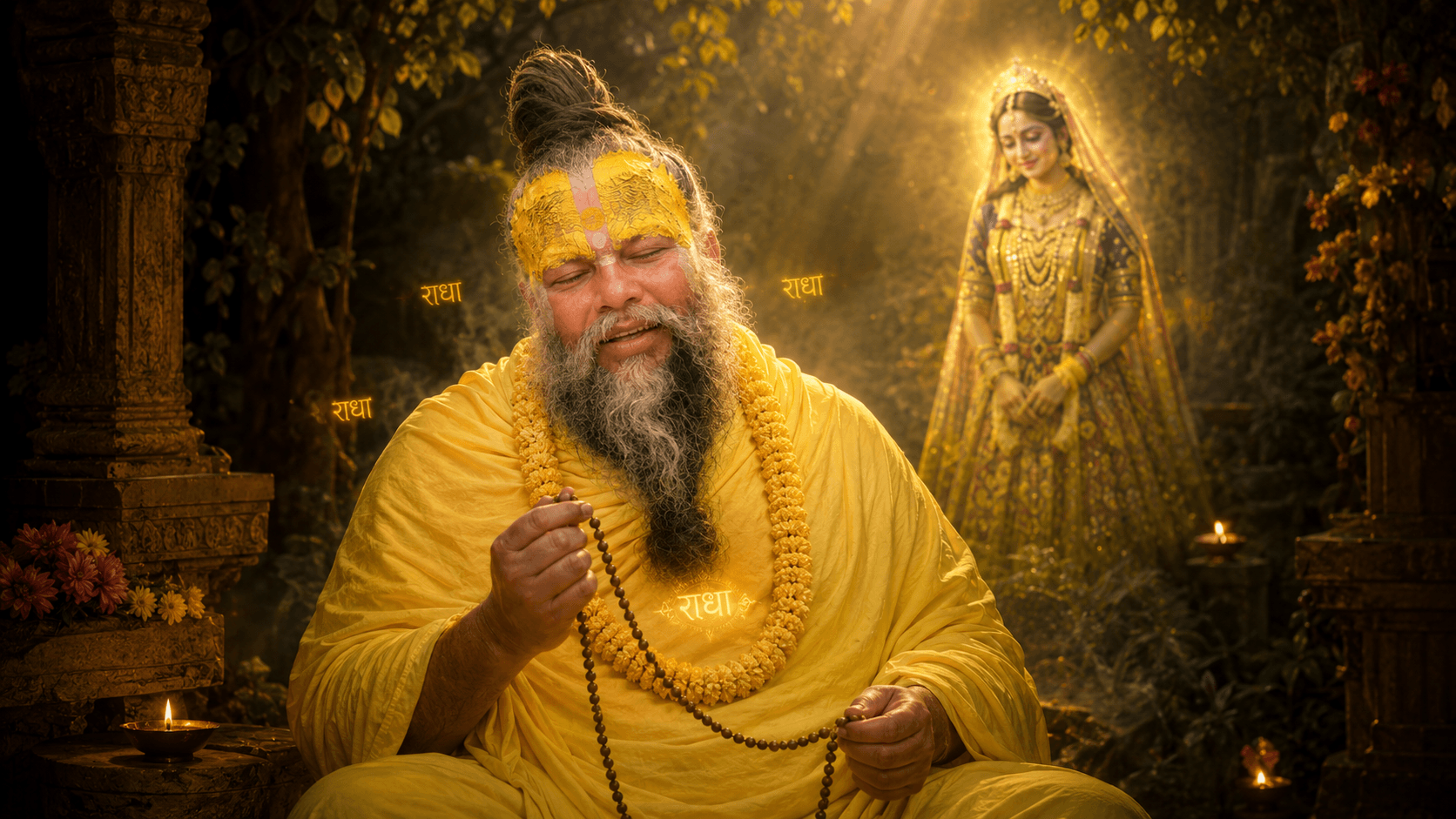
Chanting “Radha… Radha…” feels natural when life is peaceful.
But what happens when the body is ill, the heart is hurt, prayers seem unanswered, or the future feels frightening?
Premanand Ji Maharaj’s guidance on Radha Naam during difficult times is not based on pretending that pain does not exist. His teaching is about refusing to let suffering become complete forgetfulness of Shri Radha.
During a difficult period, a large target may feel impossible. A devotee can maintain a small daily Sankalpa using the Radha Naam Japa Counter and continue uncounted remembrance whenever possible.
Hardship does not disqualify you from Naam.
Sometimes it becomes the very moment when Naam is needed most.
Why Is It Hard to Chant During Suffering?
Pain pulls attention toward itself.
When someone is unwell, the mind may remain occupied with symptoms, medical reports, treatment, financial pressure and fear about what may happen next.
Emotional suffering can be equally overwhelming.
Grief, loneliness, humiliation, disappointment or heartbreak may leave little inner space for devotional feeling.
A devotee may quietly wonder:
“If Radha Rani is merciful, why am I going through this?”
There is no responsible one-line answer to every person’s suffering.
Spiritual practice does not make the human body immortal. Bhakti does not prevent every illness, loss or worldly difficulty. Feeling frightened or emotionally exhausted does not automatically mean that faith is weak.
Premanand Ji Maharaj’s teaching encourages remembrance within suffering. It should not be understood as a rejection of doctors, treatment, rest or responsible care.
Naam Japa may provide spiritual support, but it should not replace qualified medical or mental-health care.
What Does Unwavering Naam Japa Mean?
Unwavering Naam Japa does not mean that the mind never becomes tired, afraid or discouraged.
It means that whenever remembrance breaks, the devotee returns.
On a peaceful day:
Radha.
On an ordinary day:
Radha.
On a painful day, perhaps with a weaker voice:
Radha.
This steadiness is called Nishtha—firmness in devotion.
Premanand Ji Maharaj presents genuine Nishtha as remembrance that is not completely controlled by changing circumstances. The devotee may experience comfort or discomfort, praise or criticism, hope or disappointment.
Yet the Divine Name is not willingly abandoned.
Unwavering devotion is not never falling. It is repeatedly refusing to leave the Divine Name.
Also Read: Radha Naam Anushthan
Maintain a Small Radha Naam Practice During Difficult Days
When health or circumstances become difficult, your normal practice may no longer be realistic.
Do not turn this change into guilt.
You may:
reduce a large daily count;
keep a small minimum practice;
chant softly if speaking is tiring;
use mental Japa when appropriate;
listen to Radha Naam Kirtan when active chanting is difficult;
repeat one sincere “Radha” whenever awareness returns.
The important principle is:
Continuity according to capacity.
A person in severe pain should not be told to sit in an uncomfortable posture for hours.
Someone who is ill should not neglect sleep, medication or treatment to protect an arbitrary Japa number.
The external form of practice may temporarily change.
The relationship with Naam can still remain.
Premanand Ji Maharaj’s Teaching: Do Not Make Naam Dependent on Comfort
A subtle habit often develops:
“I will chant properly when I feel better.”
But after the body improves, another problem may appear.
Then there is work.
Then tiredness.
Then emotional stress.
If remembrance always waits for ideal conditions, the ideal day may never come.
Premanand Ji Maharaj encourages devotees to remember Naam while walking, sitting, waking, working and passing through both happiness and sorrow.
A more stable approach is:
“Whatever today allows, I will offer that much Naam sincerely.”
This does not mean ignoring physical limitations.
It means preventing difficulty from turning into total spiritual forgetfulness.
Even one clear repetition can preserve the inner connection:
Radha.
Radha Naam as Inner Support During Physical Pain
When the body is hurting, attention can become completely trapped inside pain.
In the teaching associated with Premanand Ji Maharaj, continuous “Radha Radha” remembrance offers the heart another place to rest—even while bodily suffering remains.
Radha Naam may give a devotee:
a sacred point of attention;
courage during uncertainty;
a feeling of Divine companionship;
a simple prayer when longer prayer feels impossible;
relief from being mentally consumed only by fear;
spiritual steadiness during treatment.
This must be understood carefully.
Radha Naam is not a guaranteed cure for cancer, kidney disease, chronic pain or any other illness.
It should never be used to pressure someone into stopping treatment.
A balanced understanding is:
Medical care addresses the body. Naam may support the heart through what the body is facing.
They do not need to compete.
Become the Witness, Not Only the Sufferer
Premanand Ji Maharaj’s discourse also uses the spiritual idea of the Drashta—the witness.
When pain becomes intense, a person may begin feeling:
“I am nothing except this suffering.”
The witness perspective creates a little inner distance.
It does not deny the pain.
It does not mean pretending that a diagnosis is unreal or refusing help.
It means remembering:
“Pain is happening, but my entire spiritual identity is not exhausted by this painful moment.”
The body may be unwell.
The mind may be frightened.
Yet the capacity to remember Shri Radha has not necessarily disappeared.
Radha Naam gives awareness something deeper than bodily discomfort to return to.
This is a spiritual perspective, not psychological or medical treatment.
The Fish and Water: When Naam Becomes Essential
Premanand Ji Maharaj’s teaching uses the image of a fish and water.
A fish does not occasionally visit water.
Water is essential to its life.
This analogy describes an advanced stage of devotion in which forgetfulness of the Divine feels spiritually unbearable.
The journey may develop gradually.
A beginner thinks:
“I should chant Radha Naam.”
A regular practitioner feels:
“My day feels incomplete without Japa.”
A deeply attached devotee feels:
“I do not want to live in forgetfulness of Radha.”
This image should inspire beginners, not shame them.
It does not mean someone has no Bhakti simply because they are still developing regularity.
Attachment to Naam grows through practice, Kripa and repeated remembrance.
The fish-and-water analogy shows the direction of the path:
Naam gradually becomes less like an optional activity and more like the inner environment in which the heart wishes to live.
The Chatak Bird: Devotion Without Bargaining
The second powerful image is the Chatak bird.
In devotional poetry, the Chatak is described as waiting only for rain from the cloud. Even if hail falls, it does not change its chosen direction.
Premanand Ji Maharaj uses this image to explain Nishtha.
Many people remember God while their wishes are being fulfilled.
But when life does not follow their plan, the relationship becomes conditional:
“If You help me, I will remember You.”
The Chatak image asks a more difficult question:
“Will I continue remembering Radha even when my life is not unfolding as I hoped?”
This is devotion beyond bargaining.
However, the metaphor must not be misused.
It does not tell anyone to remain in an abusive relationship, ignore medical danger or accept preventable harm.
It concerns steadfast remembrance of the Divine—not passive acceptance of human abuse or negligence.
Is Every Hardship Divine Grace?
Premanand Ji Maharaj’s devotional teachings sometimes interpret suffering as purification, the weakening of attachment or an opportunity for deeper surrender.
A devotee may choose to pray:
“I do not understand this difficulty, but please let it bring me closer to You rather than farther away.”
That spiritual response can transform the way suffering is carried.
But it would be irresponsible to declare:
“Every illness was definitely sent by Shri Radha to clear past karma.”
No one should casually judge the hidden cause of another person’s pain.
Within devotional interpretation, a seeker may receive adversity as an opportunity for remembrance, surrender and inner growth.
That is different from claiming to know exactly why every tragedy occurred.
Spiritual teaching should comfort the sufferer—not blame them.
Chanting Radha Naam During Emotional Pain
Radha Naam during adversity is not limited to physical illness.
The heart may suffer through:
grief;
loneliness;
rejection;
heartbreak;
failure;
humiliation;
uncertainty;
fear of the future;
feeling abandoned by God.
During emotional pain, do not force yourself to act cheerful.
A simple practice can be:
Acknowledge honestly what you are feeling.
Sit with the emotion without turning it into self-condemnation.
Repeat slowly: “Radha… Radha…”
Let the Name remain present beside the pain.
Seek trusted human, professional or spiritual support when needed.
Naam does not always remove the storm immediately.
Sometimes Radha Naam becomes the handrail that keeps the devotee from being swept away by it.
What If You Feel Angry With God?
Devotion does not require fake politeness.
During suffering, a person may feel hurt, confused or angry with Radha Rani.
Instead of abandoning Naam completely, bring that emotion into prayer:
“Radha Rani, I do not understand what is happening. I feel hurt and afraid. Please do not allow me to forget You.”
Honest prayer can be part of Sharanagati—surrender.
You are not pretending that everything feels wonderful.
You are bringing your real condition before the Divine.
The prayer is not:
“Make me emotionally perfect immediately.”
It is:
“Even in this condition, please keep me near Your Name.”
Also Read: Why Does the Mind Wander During Radha Naam Japa?
Should You Continue a Large Sankalpa During Illness?
Not necessarily.
A Sankalpa should support devotion—not become a form of self-harm.
During illness, you may need to:
reduce the count;
chant in shorter sessions;
move from spoken to mental Japa;
rest between repetitions;
listen to Naam when active chanting is difficult;
follow medical advice;
speak with your Guru regarding a formal vow.
A missed or reduced count does not mean Shri Radha has rejected you.
The wiser principle is:
Preserve the relationship with Naam, even when the outer form of practice must change.
A formal Guru-given Sankalpa should be adapted only according to the Guru or lineage’s guidance.
Naam During Happiness Is Equally Important
Many people remember God during crisis and forget Him when life improves.
Premanand Ji Maharaj’s teaching points toward remembrance through both:
health and illness,
gain and loss,
honour and humiliation,
joy and sorrow.
Radha Naam should not become an emergency number used only when life breaks.
During suffering, Naam becomes shelter.
During happiness, Naam becomes gratitude.
Radha Naam is not only support in sorrow. It is remembrance in joy.
True steadiness means that neither pain nor pleasure completely takes the Divine Name away.
A Simple Practice for Difficult Moments
When fear or pain suddenly rises, try this simple practice.
Stop for one breath
Do not attempt to solve your entire future in one moment.
Say one clear Naam
Radha.
Hear it
Let the mind register Whom you are remembering.
Repeat according to capacity
It may be eleven repetitions, a few minutes, or only one sincere Naam at a time.
Offer the fear
Inwardly pray:
“Please remain with me. Please do not let me forget You.”
Take the necessary practical action
Call the doctor.
Take prescribed medicine.
Speak with a trusted person.
Leave an unsafe situation.
Complete the responsibility before you.
Surrender does not mean refusing appropriate action.
Signs That Naam Is Giving Inner Strength
Do not judge the practice only by whether the external problem disappears.
Inner signs may include:
fear no longer controls every thought;
Radha Naam returns during panic;
suffering produces prayer rather than complete abandonment;
courage grows to take necessary action;
bitterness begins to soften;
compassion for other sufferers increases;
dependence upon Shri Radha deepens;
happiness no longer causes complete forgetfulness.
The strongest sign may not be that life became easy.
It may be that difficulty could not completely take remembrance away.
Let No Circumstance Take Radha Naam Away From You
The body may become tired.
The mind may become frightened.
Circumstances may refuse to obey your wishes.
Even devotion may temporarily feel dry.
But one possibility remains:
Radha.
The purpose of chanting Radha Radha in difficult times is not to deny pain.
It is to refuse to let pain become complete forgetfulness.
In happiness, chant with gratitude.
In sorrow, chant for shelter.
In confusion, chant as prayer.
In weakness, chant according to capacity.
Let the practice change when it must.
Rest when the body needs rest.
Seek help when help is needed.
But whenever awareness returns, let the heart return too:
Radha… Radha…
Every circumstance may change.
Do not willingly surrender the remembrance of Shri Radha.
Frequently Asked Questions
Can I chant Radha Naam during illness?
Yes. Chant according to your physical capacity while continuing appropriate medical treatment and rest.
Does Radha Naam cure physical disease?
It should not be presented as a guaranteed medical cure. For a devotee, Naam may provide spiritual courage, remembrance and inner support alongside treatment.
What does Premanand Ji Maharaj teach about suffering?
His teachings encourage remembrance through suffering, reduced identification with the temporary body and greater surrender to the Divine Name.
What if I cannot complete my normal count while sick?
Reduce or adapt the practice according to capacity. A small sincere practice is better than causing physical harm or abandoning Naam entirely.
Is suffering always punishment for past karma?
That should not be claimed universally. Some devotional traditions interpret suffering through karma or purification, but another person’s pain should never be judged carelessly.
Can I chant while feeling angry or emotionally broken?
Yes. Bring the emotion honestly into prayer and return gently to: Radha.