
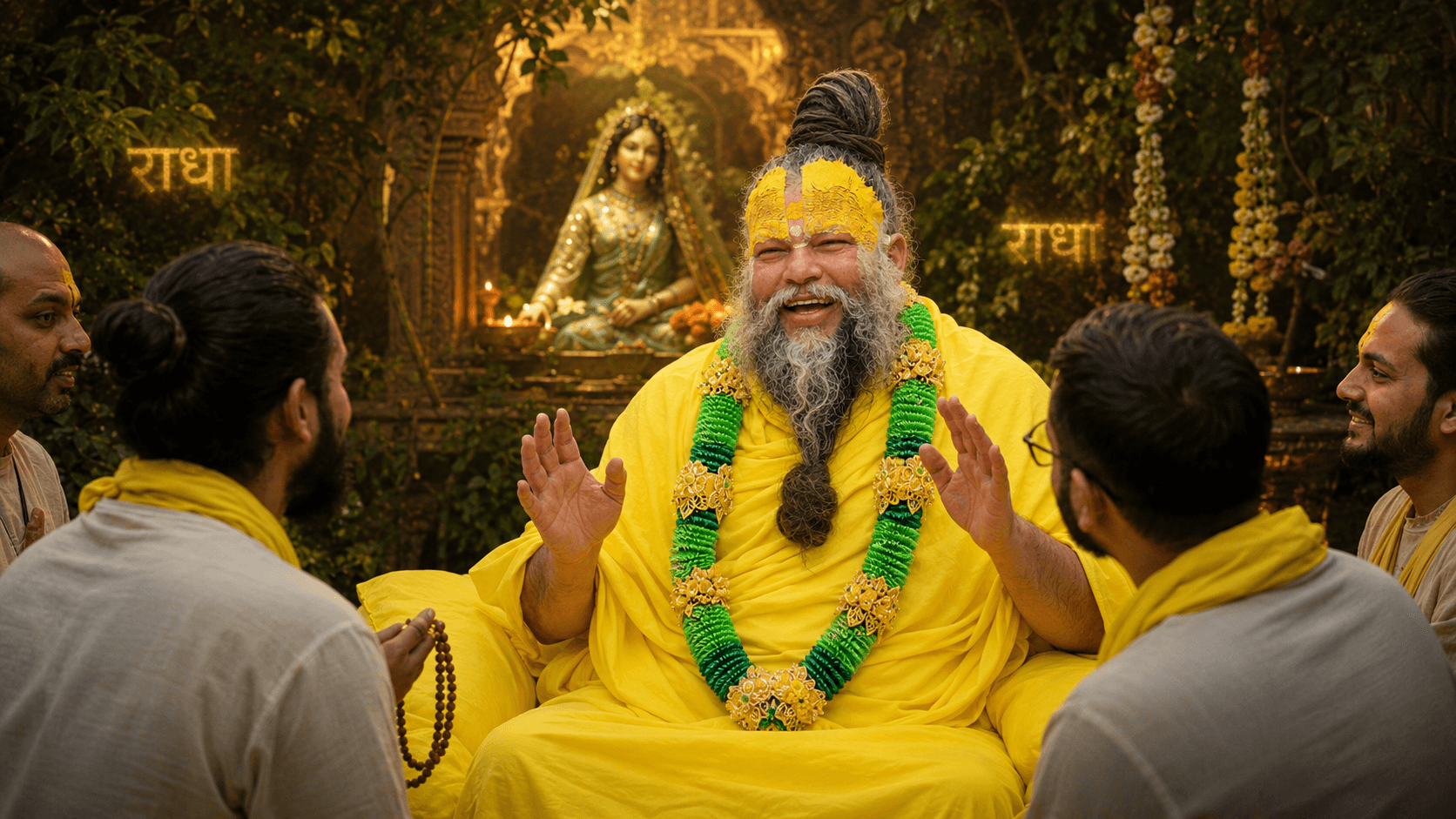
Many people feel deeply inspired after listening to Premanand Ji Maharaj and begin chanting:
“Radha… Radha…”
But after a few days, the first excitement may fade.
The mind wanders. Japa becomes fast and mechanical. Some people stop because they do not feel devotion, peace or spiritual sweetness.
The teachings of Premanand Ji Maharaj on Radha Naam are especially helpful at this stage.
He does not present Naam Japa as a temporary emotional experience. He teaches it as a lifelong path of discipline, remembrance, inner purification and love for Shri Radha.
A beginner may use the Radha Naam Japa Counter to maintain a sincere daily count. But Maharaj Ji’s deeper message is clear: the counter should help us remember Radha—not give us permission to forget Her after the count is complete.
What Does Premanand Ji Maharaj Teach About Radha Naam?
For Shri Hit Premanand Govind Sharan Ji Maharaj, Naam Japa is not merely the movement of the tongue or fingers over a mala.
Its purpose is to gradually bring the mind, speech and heart toward the Divine Name.
His teachings repeatedly emphasize:
continuing even when emotion is absent;
chanting with awareness rather than speed;
using discipline to establish the practice;
protecting Japa through truthful conduct;
carrying Naam into ordinary daily life;
remaining steady during distraction and difficulty.
These seven teachings form a practical path for anyone who sincerely wants Radha Naam to become more than a short daily activity.
1. Keep Chanting Even When You Feel No Emotion
One of the most common doubts is:
“I chant Radha Naam, but I do not feel devotion. Is my Japa useless?”
Premanand Ji Maharaj teaches that the absence of tears, bliss or strong emotion is not a reason to abandon Naam.
A beginner may chant with:
a distracted mind;
weak concentration;
little spiritual feeling;
no visible inner experience.
The instruction is still to continue.
In one of his devotional explanations, Maharaj Ji uses the example of fire. Fire retains its nature whether someone touches it knowingly or without fully understanding it.
In the same devotional sense, he explains that the Divine Name should not be judged only by the feeling of one particular session.
You may not feel sweetness today.
Still chant:
Radha… Radha…
The heart does not always develop attachment immediately.
At first, practice may be maintained by discipline. With regular remembrance, interest may grow. Interest can become attachment, and attachment may gradually deepen into Bhakti.
Do not wait for devotion before chanting. Continue chanting so devotion can gradually awaken.
This is a devotional teaching—not a scientific or medical claim. Its practical message is that spiritual dryness should not become an excuse to leave the path.
Also Read: Why Does Premanand Ji Maharaj Emphasize “Radha” Naam?
2. Chant Slowly Enough to Hear and Register the Name
Premanand Ji Maharaj gives very specific guidance about mechanical chanting.
Sometimes the tongue says:
Radha-Radha-Radha-Radha…
The fingers move quickly over the Tulsi mala.
The count increases.
But the mind never properly notices the Name.
Maharaj Ji advises devotees to chant clearly enough that the Name is heard and mentally registered.
For simple Radha Naam Japa, remember:
Speak: Radha
Hear: Radha
Remember: Shri Radha
This does not mean everyone must chant at one fixed speed.
The principle is awareness.
Do not rush so much that “Radha” becomes an unclear sound made only to finish the next mala.
Each repetition should give the mind another chance to return.
If attention has wandered, hearing your own voice can bring it back.
The purpose is not merely to make the counter move. The purpose is to make the mind return to Radha.
Fast chanting may be natural in Kirtan or established practice, but for a beginner struggling with awareness, clarity is usually more helpful than speed.
3. A Fixed Count Helps Build Discipline in the Beginning
Premanand Ji Maharaj does not dismiss counting.
A fixed daily count can be extremely useful when the practice is new.
Without a clear rule, a person may think:
“I will chant sometime today.”
Morning passes.
Then afternoon.
By night, the Japa is forgotten.
A fixed count provides:
structure;
accountability;
a daily Sankalpa;
a minimum practice;
protection from irregular chanting.
A devotee may use a Tulsi mala, a manual counting device or a digital Japa counter.
These tools are not spiritually superior or inferior to one another simply because one is traditional and another is digital.
Their practical role is to help the devotee remain regular.
But a count is not proof of spiritual greatness.
Someone chanting ten malas is not automatically more devoted than someone sincerely chanting one.
The number shows how many repetitions were counted.
It cannot fully measure love, humility, surrender or remembrance.
4. Do Not Forget Radha After Completing Your Daily Count
This is one of the most important teachings for anyone using a mala or counter.
A subtle mistake occurs when the devotee thinks:
“My required count is finished. My duty toward Naam is over for today.”
The count that was meant to support remembrance can then become its boundary.
Premanand Ji Maharaj’s guidance on Radha Naam Anushthan warns against treating Naam as a limited numerical project:
Start it.
Complete the target.
Then leave it behind.
Radha Naam is not meant to become a task that is permanently checked off a list.
Formal Japa may have a beginning and an end.
The relationship with Shri Radha does not.
After completing the daily count, Naam can still return:
while walking,
during quiet work,
while waiting,
before sleeping,
or during an emotionally difficult moment.
Use the count as a doorway into remembrance—not as the closing door of remembrance.
The best relationship with a counter is balanced:
Use it to strengthen formal practice.
Then allow uncounted Naam Smaran to continue freely.
5. The Higher Goal Is Continuous Naam Japa
Premanand Ji Maharaj often speaks about continuous remembrance.
This does not mean a beginner should immediately claim to be chanting twenty-four hours a day.
Continuous Naam develops gradually.
Stage 1: Formal counted Japa
You deliberately sit and chant for a chosen count or period.
Stage 2: A daily habit develops
The practice becomes part of your normal routine.
Stage 3: Radha Naam returns during the day
Without planning it, you remember:
Radha.
Stage 4: Remembrance becomes increasingly continuous
Naam begins accompanying more of your life—during work, rest, happiness and difficulty.
This is sometimes connected with the ideal of Ajapa Japa, where Divine remembrance is no longer limited to deliberate spoken repetition.
But such a stage should not be claimed casually.
It develops through perseverance, grace and deepening practice.
Premanand Ji Maharaj’s guidance is practical:
Begin with what you can honestly maintain.
Then allow remembrance to expand according to your capacity and spiritual guidance.
At first, you make time for Radha Naam. Gradually, Radha Naam begins to accompany your time.
6. Protect Naam Japa Through Truthful and Disciplined Speech
This teaching makes Premanand Ji Maharaj’s Naam Japa rules different from generic advice about sitting, posture and counting.
He places great importance on how the tongue is used during the rest of the day.
If the tongue spends hours in:
gossip;
criticism;
falsehood;
anger;
arguments;
harmful speech;
endless unnecessary conversation;
it becomes difficult to suddenly make that same tongue peaceful and absorbed in:
Radha… Radha…
Maharaj Ji teaches that restraint of speech supports deeper Naam Japa.
This does not mean every householder must stop speaking or withdraw from family and society.
The teaching is about purity and control, not unhealthy isolation.
Speak when needed.
Speak truthfully.
Avoid speech that deliberately harms others.
Reduce the habit of constant criticism.
Silence unnecessary words where possible.
Naam is not only a practice performed with the tongue. The way the tongue is used throughout the day affects the depth of Japa.
This is why progress in Radha Naam cannot be measured only through a counting device.
A rising count should gradually be accompanied by cleaner speech and more careful conduct.
7. Continue Naam During Distraction, Difficulty and Suffering
It is easy to chant when the mind feels peaceful and life is going well.
Nishtha—steadiness—is tested when circumstances change.
Premanand Ji Maharaj teaches that Naam should not depend entirely on:
good health,
emotional comfort,
support from others,
or immediate spiritual experiences.
The mind may become disturbed.
The body may become unwell.
A person may face pain, loss, disappointment or uncertainty.
Naam does not require the devotee to pretend that suffering is not real.
It gives the heart something sacred to hold onto within the suffering.
Radha… Radha…
may become an inner thread that remains even when outer life feels unstable.
This does not mean Radha Naam cures disease or replaces medical care.
Physical and mental-health conditions still require appropriate treatment.
The spiritual teaching is different:
Naam can become a source of courage, steadiness and Divine remembrance while a devotee passes through suffering.
A sincere seeker does not remember Radha only when life feels pleasant.
The deeper aspiration is to remain connected through both joy and difficulty.
What Prevents Naam Japa From Becoming Deep?
Based on Premanand Ji Maharaj’s teachings, several habits can weaken the practice:
chanting too quickly to notice the Name;
failing to listen while chanting;
irregular practice;
expecting immediate bliss;
excessive worldly attachment;
uncontrolled or dishonest speech;
constant criticism;
completing a quota and forgetting Naam;
becoming discouraged by a wandering mind.
Sometimes people say:
“There is no joy in my Japa.”
But the mind may still be deeply attached to endless worldly stimulation.
It expects Naam to compete instantly with habits strengthened over many years.
Maharaj Ji’s teaching is to continue patiently while also improving conduct.
Do not demand immediate sweetness while protecting every habit that keeps the mind scattered.
Does Premanand Ji Maharaj Teach Only Radha Naam?
Premanand Ji Maharaj is deeply associated with Radha Naam, Vrindavan Bhakti and the path centered on Shri Radha.
Yet deep commitment to Radha Naam does not require insulting Ram Naam, Krishna Naam, Shiva, Durga or another authentic Divine Name.
His broader guidance encourages devotees to remain steady in the Name they love or the Guru Mantra they have received.
At the same time, they should avoid sectarian criticism.
A devotee may lovingly chant:
Radha… Radha…
while respecting another devotee who says:
Ram
or
Krishna.
Nishtha means complete commitment to your chosen path—not disrespect toward another devotee’s path.
Firm devotion and spiritual humility can exist together.
Also Read: How Many Times Should You Chant Radha Naam
How to Apply These Teachings in Daily Life
Keep the application simple.
Maintain a minimum daily rule
Choose a count or duration you can honestly continue.
Chant clearly
Let your ears and mind notice:
Radha.
Return after distraction
Do not turn wandering thoughts into a reason to stop.
Protect your speech
Reduce gossip, argument, harshness and unnecessary criticism.
Continue uncounted remembrance
After formal Japa, let Radha Naam return naturally during suitable daily moments.
Observe inner change
Ask yourself:
Is remembrance increasing?
Is my speech becoming cleaner?
Am I criticizing others less?
Is my attachment to Naam growing?
Am I becoming steadier during difficulty?
Do not judge progress only by tears, visions, emotional displays or enormous counts.
Radha Naam Is a Lifelong Relationship
The central message of Premanand Ji Maharaj Radha Naam teachings is not:
“Increase the number at any cost.”
It is:
Chant even when emotion is absent.
Hear the Name.
Remain regular.
Use counting wisely.
Protect the practice through truthful speech.
Remember Radha after the count is complete.
And continue returning during difficult days.
A counter may establish discipline.
Attentive chanting may gather the mind.
Controlled speech may protect remembrance.
Perseverance may carry Naam through suffering.
But the deeper aspiration is this:
Radha Naam should gradually move from a daily task into a lifelong relationship.
Begin with the repetition you can maintain today.
Then let every sincere:
Radha
bring the mind back again.
Not only until the counter stops—
but until remembrance begins finding its own place within your life.
Frequently Asked Questions
What does Premanand Ji Maharaj say about Radha Naam?
He teaches that Radha Naam should be practised consistently and attentively, with the higher aim of carrying remembrance beyond formal counted Japa into daily life.
Does Naam Japa work without devotion or concentration?
Premanand Ji Maharaj teaches that weak concentration or lack of immediate emotion is not a reason to stop chanting. The devotee should continue sincerely and repeatedly return to the Name.
Does he recommend using a mala or counter?
Yes, his guidance recognizes fixed counts, malas and counters as useful supports for establishing discipline, especially in the beginning.
What does he say about fast chanting?
He cautions against chanting so rapidly that the practitioner no longer hears or mentally recognizes the Divine Name. Awareness matters more than simply finishing quickly.
What is continuous Naam Japa?
It is the gradual extension of Divine remembrance beyond a formal Japa session, so Naam increasingly accompanies ordinary daily life.
Does Premanand Ji Maharaj disrespect other Divine Names?
No. His wider teaching supports steadiness in one’s chosen Name or Guru-given path while respecting other genuine Divine Names and traditions.