
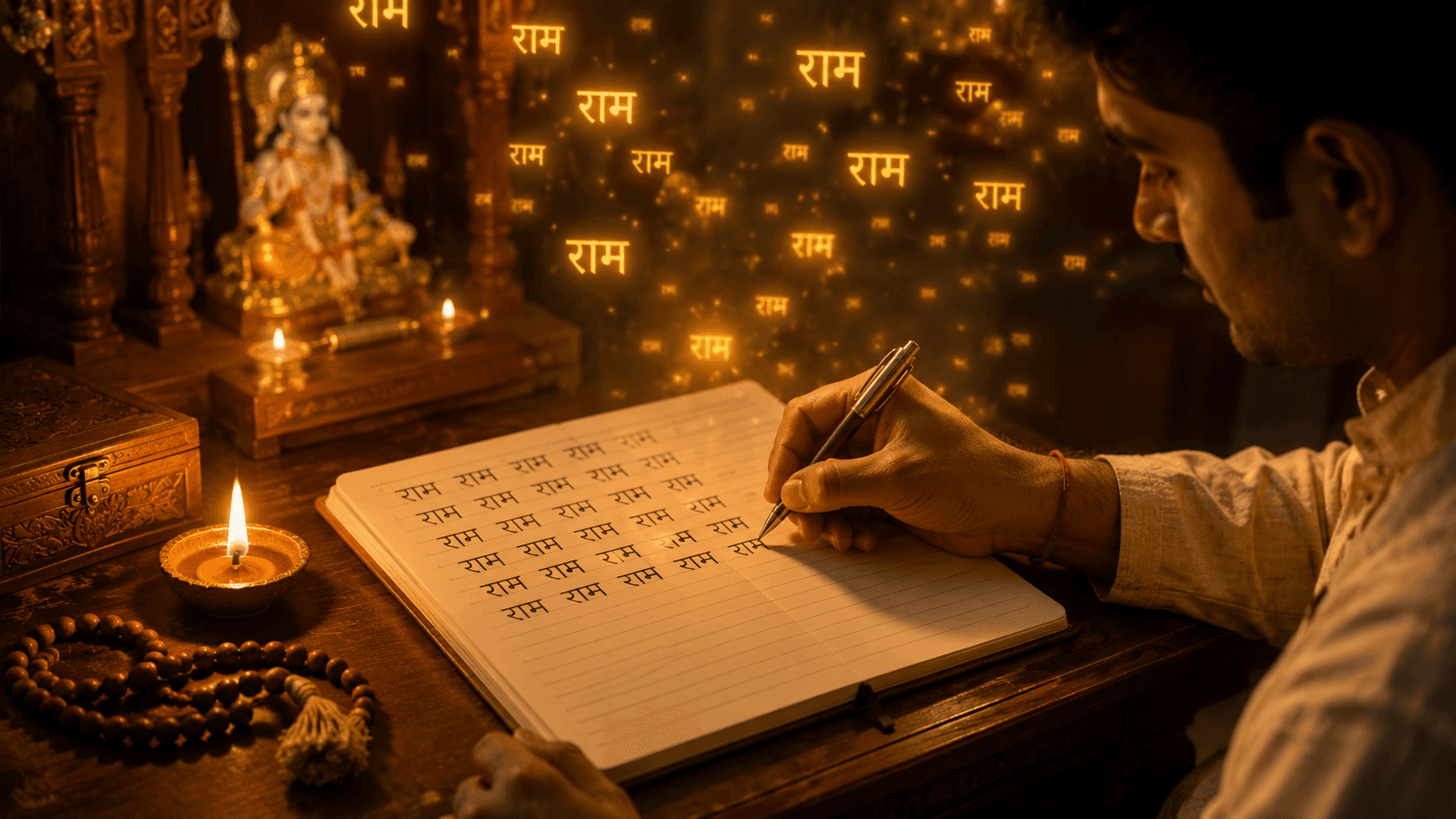
There are many ways to remember Shri Ram.
Some devotees chant His name.
Some repeat it silently in the mind.
Some sing it with devotion.
And some sit with a pen and slowly write:
राम
श्री राम
Again.
And again.
This simple devotional practice is known as Ram Naam Lekhan or Likhita Japa—written Japa.
When you write Ram Naam, remembrance becomes a physical act.
Your hand writes.
Your eyes see the Name.
Your mind returns to Shri Ram.
The benefits of writing Ram Naam are not about magical ink, a special notebook, or filling the greatest number of pages.
The real purpose is much simpler:
To give your attention, your time and your heart to the remembrance of Lord Rama.
What Is Ram Naam Lekhan or Likhita Japa?
Ram Naam Lekhan means repeatedly writing the sacred name of Lord Rama as a devotional practice.
Likhita means written, while Japa refers to repeated remembrance or repetition of a Divine Name or mantra.
So Likhita Japa simply means:
Japa through writing.
A devotee may write:
राम
श्री राम
Shri Ram
or another Rama Nama or mantra followed according to personal devotion, Guru or tradition.
While writing, the practitioner may also quietly or mentally repeat the Naam.
This is not merely a modern idea.
The Divine Life Society, in teachings attributed to Swami Sivananda, specifically describes daily mantra-writing as Likhita Japa and recommends keeping the mind on God while writing. It also states that mantra-writing is not restricted to one particular script or language.
There are also documented examples of large collective Likhita Japa practices. Chinmaya Mission records that, for the Ram Mandir at Sidhbari, 7,844 devotees from 24 countries collectively wrote 2,884,875 repetitions of “Om Sri Ram Jaya Ram Jaya Jaya Ram” as part of a Likhita Japa Yajna.
Devotees who combine writing with spoken or mental Japa can use the Ram Naam Japa Counter to keep their counted chanting practice separate and accurately tracked.
What Are the Benefits of Writing Ram Naam?
Writing changes the experience of Japa.
You cannot write as quickly as you can speak.
The hand must move.
The eyes remain on the page.
And that simple slowing down can create a different kind of devotional attention.
1. Writing Ram Naam Can Improve Concentration During Japa
Have you ever started mental Japa and, within a minute, found yourself thinking about something completely different?
The mind wanders easily.
Writing gives it more to stay connected with.
Your hand is forming:
श्री राम
Your eyes are seeing:
श्री राम
And your mind is remembering:
Shri Ram.
Traditional Likhita Japa teachings specifically describe mantra-writing as an aid to concentration because the eyes and physical activity remain engaged with the mantra.
This does not mean science has specifically proven special neurological effects from writing Ram Naam.
It simply means that, as a practice, writing can give a wandering mind a clear physical point of focus.
2. Ram Naam Lekhan Naturally Slows the Practice Down
Spoken Japa can become very fast.
Sometimes too fast.
The lips continue:
Ram-Ram-Ram-Ram…
while the mind has already gone somewhere else.
Writing is different.
You must form each word.
राम
Then the next.
राम
That natural slowness can encourage more deliberate remembrance.
It gives you a moment to notice the Naam rather than simply rush towards a number.
Slower does not automatically mean spiritually superior.
But for someone whose Japa easily becomes mechanical, Ram Naam writing can become a gentle way to slow down and return to attention.
Also Read: Sita Ram Mantra
3. It Engages the Mind and Body in Divine Remembrance
Likhita Japa brings several simple actions together:
You see the Naam.
You write the Naam.
You think of the Naam.
And, if you choose, you quietly repeat it while writing.
For some devotees, this makes the practice feel more immersive than purely mental repetition.
Swami Sivananda’s teachings describe Likhita Japa as a practice in which the mind should remain fixed on the Lord while the mantra is being written.
The hand is moving.
But the purpose is not handwriting.
The purpose is remembrance.
4. Writing Ram Naam Helps Build Discipline and Regularity
A blank notebook gives you a simple invitation:
Sit down. Write today.
You may choose:
a few minutes every morning,
one page a day,
or a personal fixed target.
There is no universal number that everyone must write.
The value comes from creating a practice you can return to.
One page may not look like much.
But one page every day becomes hundreds of pages over time.
And behind those pages is something more meaningful:
days on which you remembered Shri Ram.
Traditional spiritual-discipline guidance from the Divine Life Society even includes daily mantra-writing by minutes or pages as one possible regular Sadhana commitment.
5. A Written Record Makes Spiritual Progress Visible
Spoken words disappear into silence.
Written Ram Naam remains on the page.
You can open an old notebook and see:
page after page,
line after line,
Ram. Ram. Ram.
Those pages become a physical record of time given to spiritual practice.
Not something to show off.
Not a competition.
Not proof that one devotee is greater than another.
They simply remind you:
I returned to the Naam on these days.
A notebook slowly filling with Ram Naam can make a long spiritual journey visible in a way spoken Japa often does not.
6. Ram Naam Writing Can Deepen Bhakti and Remembrance
This is the heart of the practice.
Writing itself is not the final goal.
You could fill hundreds of pages while thinking about completely unrelated things.
The page would contain Ram Naam.
But where was the mind?
Likhita Japa becomes meaningful when writing and remembrance come together.
As Goswami Tulsidas beautifully writes in the Ramcharitmanas:
राम नाम मनिदीप धरु जीह देहरी द्वार।
तुलसी भीतर बाहेरहुँ जौं चाहसि उजिआर॥
Tulsidas compares Ram Naam to a precious lamp kept at the doorway of the tongue, bringing light within and outside.
Although this verse speaks of Ram Naam broadly rather than Likhita Japa specifically, its devotional message fits beautifully:
Keep the Divine Name close.
Writing is one more way of doing that.
How to Practice Ram Naam Lekhan
You do not need to make the practice complicated.
Choose the Form of Ram Naam You Will Write
You may choose something simple, such as:
राम
श्री राम
Shri Ram
If your Guru or spiritual tradition has given you a specific mantra or method, follow that guidance.
For a personal Sankalp, staying with one chosen form can also make the practice simpler and more consistent.
Use a Dedicated Notebook
A separate notebook can help you maintain continuity and treat the practice with care.
But do not become afraid of unnecessary rules.
There is no universal Hindu requirement that everyone must use:
a particular notebook colour,
a particular ink,
a particular direction of sitting,
or one compulsory writing format.
Different traditions and communities may follow their own customs.
Respect your tradition when you have one.
Otherwise, keep the practice simple.
Write Slowly With Attention
Do not try to win a handwriting race.
Write clearly enough that you remain aware of what you are writing.
Shri Ram.
Then again.
Shri Ram.
Swami Sivananda’s Likhita Japa guidance repeatedly emphasizes attention rather than haste while writing the mantra.
Repeat the Naam Mentally While Writing
Let the hand and mind move together.
As you write:
राम
think:
Ram.
As you write the next:
राम
remember again.
This helps prevent the practice from becoming only a handwriting exercise.
Create a Sustainable Daily Practice
Start with something you can continue.
Perhaps:
five or ten minutes,
one page,
or a personal fixed number.
Do not write hundreds of names on the first day and then never open the notebook again.
A smaller practice that becomes part of your life is more meaningful than a huge burst of enthusiasm followed by nothing.
Also Read: 1 Crore Ram Naam Japa
Writing Ram Naam vs Chanting Ram Naam: What Is the Difference?
Both practices center on remembrance of Lord Rama.
But they engage you differently.
Ram Naam Lekhan
The Divine Name is written.
It uses the hand, eyes and focused attention.
It is naturally slower.
It leaves a physical written record.
It is commonly called Likhita Japa.
Ram Naam Japa
The Divine Name is spoken, whispered or mentally repeated.
It can be practised with a mala or counter.
It can often continue more easily while sitting, walking or through different parts of the day.
It is commonly called Naam Japa or Nama Japa.
One does not need to be declared better than the other.
They can beautifully complement each other.
You may write Ram Naam during a quiet morning practice.
Chant with a mala later.
And remember Ram silently during the day.
Different forms.
One remembrance.
What Is Ram Koti?
Ram Koti or Ramakoti is strongly associated with the devotional practice of repeatedly writing the name of Sri Rama, traditionally towards a total of one crore—10 million—written names.
This association is well documented.
Tirumala Tirupati Devasthanams has distributed Ramakoti workbooks specifically for devotees to write “Sri Rama” Nama, and official TTD reports describe collections of Ramakoti books containing crores of written Rama Names.
This is an important distinction.
Ram Naam Japa may refer to spoken, whispered or mental repetition.
Ram Koti, in traditional usage, has a particularly strong association with written Rama Nama—Likhita Japa.
Usage can vary between communities, so the terms should not always be treated as perfect synonyms.
A separate 1 Crore Ram Naam Japa practice may also involve counted chanting rather than writing.
Should You Count Every Ram Naam You Write?
You may—but you do not always have to.
Some devotees use:
pre-printed grids,
notebooks with fixed boxes,
a known number of names per page,
or manual totals.
Counting is useful when you have taken a specific Sankalp, especially a large one such as Ram Koti.
But remember:
A notebook is not only a scoreboard.
You are not collecting Ram Naam like points.
The count gives structure.
The remembrance gives meaning.
There is no universal rule requiring every casually written Ram Naam to be tracked.
Make Every Written Ram Naam an Act of Remembrance
A notebook filled with Ram Naam can be beautiful.
But the empty pages are not your enemy.
And filling them as quickly as possible is not the goal.
Take your pen.
Write:
राम
Pause for a moment.
Remember whose Name you have written.
Then write again.
राम
One page may become ten.
Ten may become hundreds.
Perhaps, over many years, the count becomes enormous.
But the deepest value of Ram Naam Lekhan is not simply how many notebooks you finish.
It is how many times the act of writing gives you a reason to stop…
and remember Shri Ram.
Let every written Naam be more than ink on paper.
Let it be a moment of remembrance.
Frequently Asked Questions About Writing Ram Naam
What happens when you write Ram Naam daily?
Daily Ram Naam writing can create a regular devotional routine, encourage focused attention and keep remembrance of Lord Rama present in everyday life. Traditional teachers of Likhita Japa particularly describe mantra-writing as a practice that supports concentration. It should not be presented as a guaranteed way to obtain miracles, wealth, healing or specific material results.
What is Likhita Japa?
Likhita Japa means written Japa—repeatedly writing a Divine Name or sacred mantra as a spiritual practice. The Divine Life Society documents it as an established form of Japa practice.
Which Ram Naam should I write?
You may write a simple form such as: राम श्री राम or Shri Ram. You may also follow another Rama Nama or mantra given by your Guru or tradition.
Is writing Ram Naam better than chanting it?
There is no universal answer. Writing naturally uses visual and physical attention and leaves a written record. Chanting can be practised more continuously and in different forms. Both can support remembrance of Shri Ram.
Can I write Ram Naam in English?
Yes. Traditional Likhita Japa guidance from the Divine Life Society explicitly states that mantra-writing is not restricted to one particular script or language. So you may write: राम or Shri Ram according to your comfort, devotion and tradition.
What is Ram Koti?
Ram Koti is traditionally strongly associated with writing Rama Nama towards a total of one crore written names. Official TTD records document devotees writing Ramakoti books and preserving large collections of these written Rama Names.